Your people work in fight-or-flight all day
A stressed brain cannot plan, decide or create. Yale neuroscientist Amy Arnsten showed even mild, uncontrollable stress switches the prefrontal cortex, our thinking centre, offline.
Burnout drains your people long before it shows up as sick leave. We give them 5-minute, science-backed tools to reset calm, focus and energy, right at their desks.
Be honest for 60 seconds. Tap every moment you have seen this quarter. Most stress never reaches HR; it leaks out as sick days, short tempers and slow work.
It is rarely the workload alone. Your people are skilled and willing. The drain is in how their bodies and minds carry stress, emotions, fatigue, pain, illness and self-doubt. Tap a stage to find yours.
A stressed brain cannot plan, decide or create. Yale neuroscientist Amy Arnsten showed even mild, uncontrollable stress switches the prefrontal cortex, our thinking centre, offline.
Unspoken emotions keep the alarm ringing. UCLA brain scans showed that simply naming a feeling calms the amygdala, the brain's smoke detector (Lieberman, 2007).
Every organ keeps its own 24-hour clock, the discovery behind the 2017 Nobel Prize in Medicine. Work against it, and energy, focus and mood crash.
Pain costs most at the desk, not at home: common pain conditions cost US employers $61.2 billion a year in lost productive time, mostly from people still at work (JAMA, 2003).
A review of 300 studies found chronic stress steadily weakens the immune system (Segerstrom and Miller, 2004). Your sick-leave register is the proof.
Beliefs change biology. Hotel housekeepers simply told that their work counted as exercise lost weight and lowered blood pressure within four weeks (Crum and Langer, Harvard, 2007).
Stress does not stay in the body. It shows up at work twice: once as sick days, mistakes and conflict, and again as the good people who quietly burn out and leave.
Pick the situations on the left to see your score.
stressful moments handled in survival mode, not with a skill.
Rate 12 everyday work moments, see your Team Energy Score today, and what it becomes after the program.
The program takes days. Burnout can take years to undo. Start before another quarter runs on empty.
Stop the drain: invite SaurabhFound your energy drain? Seal it before another month of stress turns into sick leave.
One feel-good session cannot undo years of stress. Real change comes from small daily resets, practised until they are automatic. Here is our journey, from the first conversation to a team that keeps recharging itself.
We learn about your people, their workload, shifts and pressure points, and give you full clarity on how we work. No assumptions on either side.
What you get: A shared, honest picture of your team's energy today.
An anonymous stress and energy pulse, conversations with managers and a look at sick-leave and attrition patterns. The real drain is often not the one first named.
What you get: The right problem, before anyone spends on a solution.
We pick the tools that fit your culture, your shifts and your budget, from desk-friendly tapping to the full 12-topic program.
What you get: A program designed for your people, not borrowed.
Every demonstration, partner exercise and case targets the drain we found, using your real pressure points: reviews, targets, night shifts and difficult customers.
What you get: Learning aimed precisely at your team's stress.
Participants agree on what must change and commit to it in their own words. Self-determination research shows chosen goals outlast imposed ones.
What you get: People who own the change, because they chose it.
We stay with your team as they use the routines at their desks, on the shop floor and before high-pressure moments.
What you get: Tools that become habits, not handouts.
Regular check-ins on stress and energy scores catch what is slipping and adjust the plan in time, the way the US Army's after-action reviews keep units improving.
What you get: Progress you can see, and problems caught early.
As new pressures appear, from restructuring to peak season, we facilitate the next learning exactly when your team needs it.
What you get: A team that keeps growing stronger after the program.
A calmer culture takes root. People reset before they snap, recover before they fall sick, and every new joiner learns it from them.
What you get: The result you invested in: lasting energy and resilience.
Training is one step out of nine. The other eight are why the results last.
Painkillers, coffee and a holiday treat the symptom; the stress is back on Monday. Toyota built its quality on asking "why?" five times. Pick your team's problem and see what changes when it is fixed at the root.
Calm is not a personality trait. It is a skill, built tool by tool. Twelve topics in seven sections take your people from the science of energy psychology to a 5-minute routine they use every morning. Each one seals a drain from episode 2. Tap the wheel.
Stress gets treated as a mind problem or a body problem, never both, so it keeps coming back.
The science: A review of 51 peer-reviewed papers in the American Psychological Association's Review of General Psychology found consistent benefits from tapping on acupoints for anxiety, phobias and trauma (Feinstein, 2012).
One person's bad mood spreads through the whole team, and nobody knows how to shift it.
The science: In a study of 701 people, every emotion showed up as its own map of sensations in the body, and the maps matched across cultures (Nummenmaa, PNAS 2014).
People say "I'm fine" while their body is shouting otherwise, until it breaks down.
Before and after: In 2010 a simple muscle-strength test with a slice of bread pointed Novak Djokovic to a gluten intolerance. He changed his diet and was world No. 1 the next year.
Energy crashes at the same time every day, and people fight it with sugar and caffeine.
The science: University of Vermont researchers found about 80% of acupuncture points sit where the connective-tissue planes between muscles meet (Langevin, 2002).
People feel stuck, ungrounded or unable to speak up, and it shows in every meeting.
Before and after: Ray Dalio, founder of the world's largest hedge fund, calls meditation, his daily practice since 1969, the biggest ingredient of whatever success he has had.
Small triggers set off big reactions: panic before reviews, anger in meetings, freezing under pressure.
The science: Just 20 seconds of soothing touch, such as a hand on the heart, lowered the stress hormone cortisol in a 2021 study (Dreisoerner, Comprehensive Psychoneuroendocrinology).
Back pain, headaches and acidity quietly eat into focus and output every single day.
The science: Melzack and Wall's gate control theory (Science, 1965) showed that touch and pressure can close the "gate" on pain signals. It is why rubbing a bump helps.
Brain fog: people read the same email three times and still miss the point.
The science: Left-right bilateral stimulation is the core of EMDR, a therapy recommended by the World Health Organization for trauma since 2013.
Every season brings a wave of coughs, colds and sick leave that empties the office.
The science: In Carnegie Mellon's landmark study, the more stressed people were, the more likely they were to catch a cold when exposed to the virus (Cohen, New England Journal of Medicine, 1991).
Anxiety before reviews, presentations and tough conversations drains performance exactly when it matters.
The science: A 2016 meta-analysis of 14 randomised trials found EFT tapping produced a large drop in anxiety (Clond, Journal of Nervous and Mental Disease).
"I can't", "not me" and "it won't work" quietly cap what your people attempt.
The science: People who asked themselves "Will I?" solved more puzzles than people who told themselves "I will" (Senay, Psychological Science, 2010).
Wellness stays a one-day event. By Monday, nobody remembers a single technique.
Before and after: Aetna's workplace mindfulness and yoga program cut employee stress by about 28% and gave back roughly 62 minutes of productive time per employee every week.
By Friday, people forget most of what they heard on Monday. They remember what they felt and did. So your people don't just hear about energy: they test it, tap it and feel it shift in their own bodies, until it becomes how they work. Tap each step and try it.
Experience, understand, practise, apply. Every session rises like a wave, with lively energizers balanced by deep, quiet moments of calm and live partner demonstrations.
Feel the 12 energy tools in action with your own team, at your own workplace.
The best way to learn healing is from someone who has had to heal. After a brain haemorrhage, doctors told Saurabh Jain he would never speak in public again; 11 months later he set his first non-stop speech world record. Over 23+ years he has conducted 2,500+ trainings across 32+ industries and held an audience for 30 hours non-stop. He brings your team both sides: the lived experience of rebuilding energy from zero, and simple, research-backed tools your people use the very same day.
A venture of Pragya. Bharat’s No. 1 Soft Skills Training Centre.
“Learning & Motivation का महाकुम्भ”, home of the 30-hour non-stop speech.
Each one could have ended the story. Tap a card and see what happened next.
जिन्दगी मैं फिर तैयार हूँ, तू कोई कमी मत छोडना मेरे मजे लेने में,क्योंकि मैं कोई कसर नहीं छोड़ने वाला तेरे मजे लेने में."Life, I am ready again. Don't hold back in testing me, because I won't hold back in living you."
Saurabh JainHis core belief: energy is not luck or mood. Calm, focus and resilience are learnable skills, and that is exactly what he teaches your team.
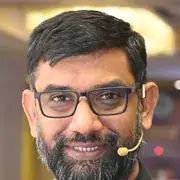
“Training is not just my profession. It's my purpose, my passion and my profession.”
Your team has sat through enough wellness talks that felt relaxing on the day and changed nothing. This is what he does differently.
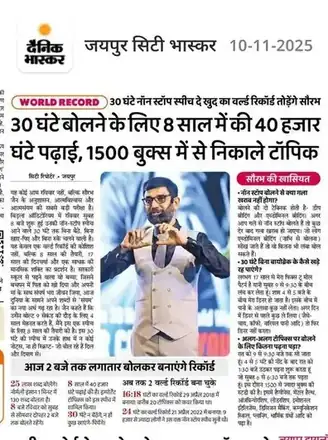
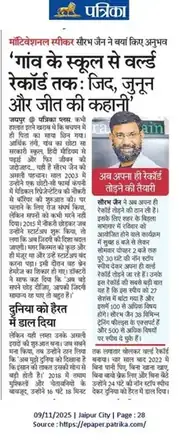
500+ media houses have covered Saurabh Jain, from Dainik Bhaskar and Rajasthan Patrika to ANI and The Print. Tap any clipping to read it.

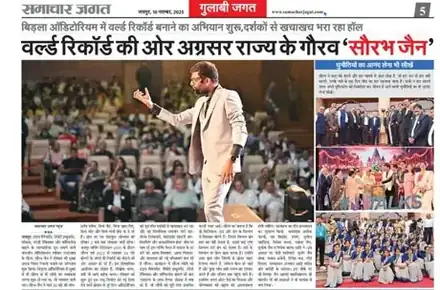
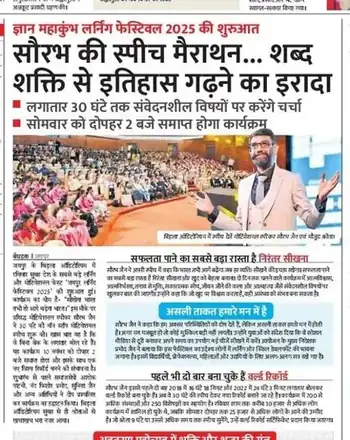
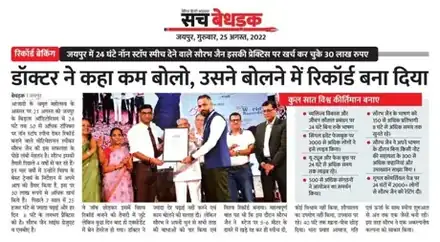
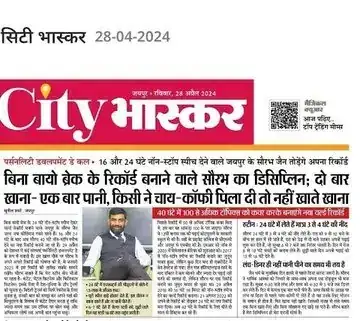
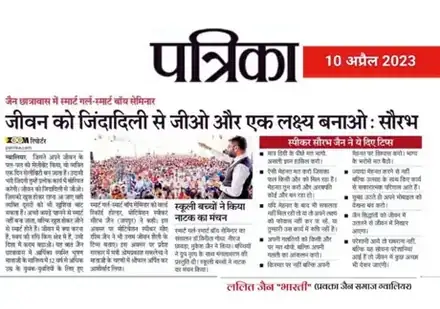
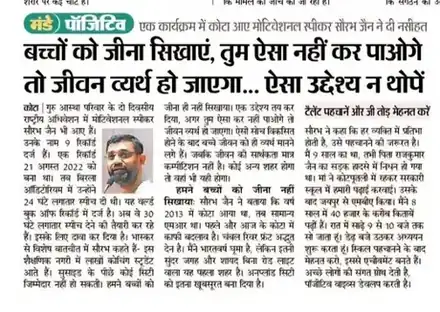
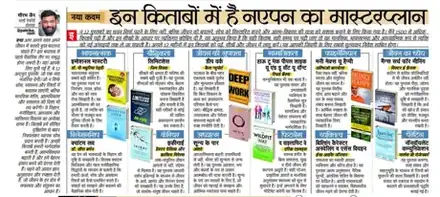
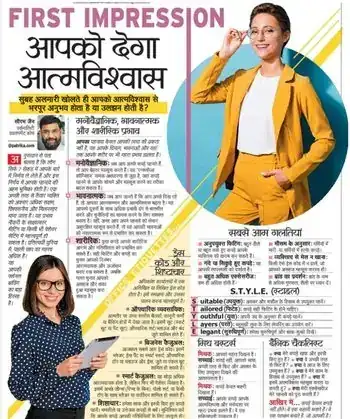
See how he holds a room and makes calm, focus and energy feel possible: the same presence your people learn to bring to every workday. Press play on any one.
Choose what is draining your team. See the result, the shift and how it will feel, for your people and for your organisation.
Hover over or tap each card to see the shift people experience with Saurabh Jain.
Most wellbeing proposals die in one meeting, on one of these five sentences. Tap yours and walk in with the answer. The decision stays yours.
If nothing changes: Your people keep managing stress with caffeine, painkillers and weekends, and the best of them burn out.
Your team doesn't need to believe anything. They try each tool, rate their own stress before and after, and keep what works. Meridians and chakras are taught as practical maps, with the research behind every tool.
Proof: In a randomised trial with war veterans, 90% of those who received six EFT sessions no longer met the criteria for PTSD, against 4% in the comparison group (Church, 2013).
If nothing changes: Wellbeing that cannot show results is the first budget line cut, and the sick days continue.
We agree the measures with you upfront: pre and post stress and energy scores, a 21-day logbook, and a 90-day look at sick leave, engagement and attrition.
Proof: A Harvard analysis of workplace wellness programs found medical costs fell about $3.27 and absenteeism costs about $2.73 for every dollar spent (Baicker, Cutler and Song, 2010).
If nothing changes: Your people already lose hours every week to fatigue, distraction and recovering from stress.
Half-day modules, staggered batches so operations never stop, weekly or online sessions, and tools that take 60 seconds to 5 minutes inside the workday.
Proof: Even while running Microsoft, Bill Gates blocked two "Think Weeks" a year just to step away, recharge and learn.
If nothing changes: A wellness day that fades is the costliest kind: you pay once, then keep paying in sick days.
Events fade when practice ends with them. Ours continues: a 21-day logbook, a 5-minute daily routine, buddy check-ins and refresher sessions.
Proof: Across 317 experiments, learning spaced out over time was remembered far better than the same learning crammed into one day (Cepeda, Psychological Bulletin, 2006).
If nothing changes: Every quarter of waiting adds more sick days, more conflict and more resignation letters.
Stress does not wait for appraisals to end, and burnout rarely announces itself before the resignation letter.
Proof: Gallup found burned-out employees are 63% more likely to take a sick day and 2.6 times as likely to be actively looking for another job.
Before you decide, see what stress quietly costs your organisation every year: sick days, hours lost at the desk and good people who burn out and quit. Being at work but not fully there often costs more than absence itself (Harvard Business Review, 2004). We use your own salary numbers and keep every assumption conservative.
If your people feel pressure, they need a way to release it, trained or not. Pick a group and see what changes for your organisation.
“Everyone is online all day, and drained by 4 pm.”
Calm, focused people who reset in five minutes, not five days.
“After one angry customer, the next five calls suffer.”
People who release a tough call in two minutes and stay warm all shift.
“Fatigue, body pain and short tempers on long shifts.”
Safer, steadier shifts with less pain and fewer errors.
“We look after everyone except ourselves.”
Compassion without burnout, and teams who look after each other.
“I carry everyone's stress home every night.”
Leaders who stay calm, model it and lift the whole team.
32+ industries. One proven way to build calmer, healthier, high-energy teams.
Pick a duration and a setting. We shape the rest around your people and your calendar.
Your team may have attended a yoga morning or a stress talk. It felt good for a day. Here is why our change lasts, and shows up in every workday.
It is not "Can we afford a wellbeing program?"
It is "Can we afford another year of burnout, sick leave and resignations?"
Saurabh Jain is a Jaipur-based energy psychology coach, healing expert and corporate trainer with 23+ years of experience. He founded EnactraX, Bharat's No. 1 Soft Skills Training Centre, and the Jaipur Learning Festival, has conducted 2,500+ trainings across 32+ industries, holds 10 World Records, including a 30-hour non-stop speech without any break, and has received 200+ awards. His Energy Psychology for Your Team program gives employees simple, research-backed tools, from EFT tapping to the energetic clock, to manage stress, pain, fatigue and limiting beliefs.
Energy psychology combines modern psychology with the body's energy system: acupoints, meridians and chakras. Its best-known method, EFT tapping, traces back to 1980, when psychologist Roger Callahan asked a patient with a lifelong water phobia to tap under her eye and her fear eased within minutes. Meta-analyses have since found large effects of EFT on anxiety, depression and PTSD, and use of mind-body and complementary approaches by US adults nearly doubled between 2002 and 2022 (JAMA, 2024). We teach meridians and chakras as practical body-awareness maps and show the research behind every tool.
Twelve practical topics in seven sections: what energy psychology is and how it works; the quantum universe and changing vibrational states; muscle testing; the meridian system and the energetic clock; the 7 chakras; the Triple Warmer and managing fight-or-flight; holistic pain and digestive relief, including colour therapy; crossing energies and the cross crawl; neuro-lymphatics and immunity boosters; the basic EFT tapping sequence; action affirmations and lofty questions for EFT; and a 5-minute daily energy routine for work. It suits corporate and IT teams, sales, service and call-centre teams, manufacturing and shift teams, healthcare and frontline teams, managers, HR and leaders.
Lower stress and calmer reactions under pressure; steadier energy through the afternoon; fewer stress-related sick days; relief from everyday aches, headaches and acidity; sharper focus; better sleep; more confidence in reviews and presentations; and people who replace limiting beliefs with empowering questions. Results are tracked through pre and post stress and energy scores, a 21-day logbook and the attendance and engagement data you already have.
The techniques are gentle, self-applied and done fully clothed, sitting or standing, and nobody is asked to share private experiences in the group. They complement, and never replace, medical care or therapy. Participants are encouraged to see a doctor for persistent pain or illness and a qualified mental-health professional for serious distress.
Half day, full day, a few days, or regular weekly or monthly sessions. Saurabh Jain delivers in-person energy psychology training anywhere in the world from his Jaipur base: your office, plant, hotel or offsite, across Rajasthan, every Indian city and internationally. Live online sessions are available in any time zone, in English, Hindi or a mix of both.
The investment depends on duration, setting, number of participants and customisation, so every organisation gets a customised proposal within one working day of the discovery call. The wellbeing ROI calculator on this page compares the cost with the sick days, lost productive hours and burnout attrition your organisation can recover.
Every participant rates their stress and energy before and after, demonstrates the tapping sequence and the daily routine, and leaves with a personal 5-minute routine and a trigger plan. We agree organisational measures with you upfront, such as sick leave, engagement scores and attrition. Each participant receives a certificate, a workbook and a 21-day logbook, and your organisation receives a summary of the change.
HR and L&D leaders: tell Saurabh Jain about your people, the pressure they carry and the change you want. Free discovery call, no obligation, and a reply within 24 hours.
Takes less than a minute.
We understand your team, their pressures and your goals.
Within one working day, shaped to your team.
Every great series ends with a celebration. With Saurabh Jain, yours starts on the last day of the program and never really ends.
Certificates, a team that has felt the shift in their own bodies, and people who walk out lighter, calmer and charged.
The logbook is complete. The 5-minute routine, a tapping round after stress and a lofty question each morning now happen without thinking.
Fewer sick days, calmer reviews and a culture where saying "I need a reset" is normal.
Energy compounds. Every calm person steadies the next, and the tools stay with your people for life, at work and at home.
“When your people's energy changes, everything they touch changes.”