Six hidden time leaks, and the price of waiting, every single month.
The 6 time leaks
Why busy teams still miss deadlines: the 6 time leaks we fix
Your people work hard. They still miss deadlines, live in meetings and take work home. Six leaks cause it. Tap a stage to find yours.
Leak 01 · Priority fog
Everything is urgent, so nothing important gets done
When every request shouts 'urgent', the strategic work waits for a quiet day that never comes. A Journal of Consumer Research study (Zhu, Yang and Hsee, 2018) found people pick urgent tasks over important ones, even when the important task pays more.
Every ping, chat and 'quick question' breaks the train of thought. UC Irvine researcher Gloria Mark found it takes about 23 minutes to get back to a task after an interruption.
Updates, calls and inbox replies crowd out the work people were hired to do. Microsoft's 2023 Work Trend Index found people spend 57% of their time communicating and only 43% creating, and 68% lack enough uninterrupted focus time.
Tasks are put off, then rushed, late or full of errors. In a classic study (Buehler and colleagues, 1994), only 30% of students finished their thesis by the date they predicted; on average it took 55 days, not 34.
Late evenings are mistaken for commitment while output per hour falls. Stanford economist John Pencavel found output rises little beyond 50 hours a week, and 70 hours produce barely more than 55.
Constant pressure with no recovery leads to exhaustion, sick leave and resignations. WHO and ILO estimate that working 55 or more hours a week was linked to 745,000 deaths from stroke and heart disease in 2016.
And how we fix the root cause, not just the surface.
The method we follow
Why most time management training fades by Monday: our 9-step training process
Most time management seminars inspire on the day and are forgotten by the next deadline. Time habits grow like a muscle, through small daily practice at real work. Here is our journey, from the first conversation with your HR and L&D team to a culture of focus and balance that stays.
Before the training · UnderstandDuring · TransformAfter · Sustain
Swipe to see all 9 steps →
01
Before the training
Deep discovery, both ways
We meet your HR, L&D and business heads to understand your teams, their workload, peak seasons and what has been tried before, and give you full clarity on how we work. No assumptions on either side.
What you get: A shared, honest picture of how time is used in your organisation today.
A short time-audit survey, calendar and meeting patterns and real workplace situations show the real gap. It is rarely 'lazy people'. More often it is unclear priorities, meeting overload, an always-on culture or managers who cannot delegate.
What you get: The right problem, before any time or budget is spent.
We shape the right mix of the ten topics, activities, duration and format for each group. Front-line staff, managers and senior leaders lose time in different ways and need different programs.
What you get: A program designed for your team, not a ready-made seminar.
Every simulation, case and activity is linked to your real situations: month-end pressure, review meetings, client deadlines, WhatsApp groups and leave planning, so each minute in the room wins back time at work.
What you get: Time skills practised on the days your people actually live.
Each participant writes a personal time commitment: the priorities they will protect, the habits they will build and the boundaries they will keep, in their own words. Self-determination research shows chosen goals outlast imposed ones.
What you get: People who own the change, because they chose it.
We help teams apply their plans in the very next week: new meeting rules, focus blocks, delegation and after-hours norms, and we clear roadblocks on the ground.
What you get: Time skills used at work, not left at the venue.
Clear priorities, protected focus and real switch-off time become 'how we work here'. At BCG, consultants given predictable time off reported higher job satisfaction and saw a longer future at the firm (Perlow, HBR, 2009).
What you get: The result you invested in: a productive team that stays.
Training is one step out of nine. The other eight are why your team keeps getting better with time.
The fix, at the root
Why Saurabh Jain's time management program fixes the root cause, not the symptom.
Another productivity tip treats the symptom, and the old habits return next quarter. Pick the time problem your organisation faces every week and see what changes when it is fixed at the root.
1What you notice
2The real root cause
3The result you get
🧭
Episode 4 of 9 · The Path
10 skills, one clear path to a focused, balanced team
Each one fixes a time leak you saw in episode 2.
What you learn
Time management training topics: 10 skills for focus, productivity and work-life balance
Time can't be stretched, but how it is used can be trained. Ten topics, in sequence, each fixing a time leak your organisation lives with every day. Tap the wheel.
01
Priorities That Matter (Eisenhower Matrix & 80/20)
The problem it solves
Everything feels urgent, so the loudest request wins and the important work waits.
Back at workEveryone starts the day knowing the three things that matter most, and does them first.
Real storyDwight Eisenhower led D-Day and two US presidential terms with one daily test: is this important, or only urgent? The matrix named after him is still the world's most used priority tool.
What you practise
Urgent vs important: the Eisenhower Matrix at work
The 80/20 rule: the few tasks that drive most results
A daily top three that survives interruptions
Re-prioritising calmly when the plan changes
02
Goal Setting & Smart Planning
The problem it solves
Goals are vague, plans live in people's heads and deadlines are guessed, not planned.
Back at workClear weekly goals, a 10-minute daily plan and deadlines that include a buffer.
ResearchLocke and Latham's goal-setting research: specific, challenging goals beat 'do your best' in about 90% of studies.
What you practise
SMART goals linked to team targets
Weekly and daily planning in 10 minutes
Beating the planning fallacy with buffers
Time-blocking the calendar before the week starts
03
Deep Work & Focus
The problem it solves
Constant pings and multitasking leave people busy all day, with little real work done.
Back at workProtected focus blocks where the most valuable work gets done, without interruptions.
Before → afterIntel, 2007: 300 engineers went offline every Tuesday morning, with no email, chat or meetings. Most asked for this 'Quiet Time' to continue and spread.
What you practise
Why multitasking is a myth: the brain's switching cost
90-minute focus blocks and team 'do not disturb' rules
A distraction-free workspace, physical and digital
Getting back into flow after an interruption
04
Beating Procrastination
The problem it solves
Important tasks are delayed until the last minute, then rushed, late or full of errors.
Back at workPeople start early, break big tasks into small steps and finish without panic.
NeuroscienceRuhr University Bochum (2018) found chronic procrastinators had a larger amygdala, the brain's threat centre. Procrastination is an emotion problem, not laziness.
What you practise
The real reasons we delay: fear, boredom and overwhelm
The 2-minute rule and the 10-minute start
Eat the frog: the hardest task first
If-then plans that make starting automatic
05
Taming Meetings, Email & Digital Distractions
The problem it solves
Meetings, email and WhatsApp eat the day, and real work moves to late evenings.
Back at workFewer, shorter meetings with clear outcomes, and messages handled in planned batches.
Before → afterShopify, 2023: the company cleared recurring meetings from every calendar and freed about 322,000 hours in a year.
What you practise
The 4-question test: does this need a meeting?
15- and 25-minute meetings with an agenda, owner and decision
Batching email and chat: three checks a day
Team norms for WhatsApp groups and notifications
06
Delegation & the Art of Saying No
The problem it solves
Managers do everything themselves, and willing people say yes to every request.
Back at workWork owned at the right level, and a polite, firm 'no' to anything that does not matter.
ResearchGallup studied 143 CEOs on the Inc. 500 list: strong delegators generated 33% more revenue than weak ones.
What you practise
What to delegate, to whom and how
Delegating outcomes, not just tasks
Saying no without guilt: 'yes, if' and 'not now' scripts
Pushing back on the boss with priorities, not excuses
07
Energy Management, Not Just Time
The problem it solves
People push through long hours without breaks and are drained by mid-afternoon.
Back at workHard work planned for peak hours, short breaks that recharge, and steady energy all day.
ResearchEricsson's famous study of elite violinists found the best practised in sessions of about 90 minutes, rarely over four hours a day, and rested more.
What you practise
Your body's 90-minute energy cycles
Matching tasks to your peak, dip and recovery hours
Micro-breaks, movement and hydration at the desk
Sleep, food and screens: the energy basics
08
Stress Control & Burnout Prevention
The problem it solves
Constant pressure turns good performers into exhausted, irritable people who start to leave.
Back at workPeople who notice stress early, reset quickly and recover before it becomes burnout.
ResearchGallup found employees who often feel burnt out are 63% more likely to take a sick day and 2.6 times as likely to be looking for another job.
What you practise
Stress vs burnout: the early warning signs
60-second resets: breathing, grounding and reframing
Honest workload conversations with your manager
Team resilience under deadline pressure
09
Work-Life Boundaries & Recovery
The problem it solves
Work follows people home through late calls, weekend messages and holidays spent on email.
Back at workClear after-hours norms, leave that is truly leave, and time and energy left for family.
Before → afterVolkswagen, 2011: email to staff phones was paused from 30 minutes after a shift ended until 30 minutes before the next one began.
What you practise
The always-on trap, and what it costs the brain
Team agreements for after-hours calls and messages
Shutdown rituals and digital sunsets
Making leave real: handovers and cover plans
10
Habits, Rituals & the Weekly Review
The problem it solves
Seminars inspire for a day, then old habits return by Monday.
Back at workA few daily time habits and a 15-minute weekly review that keep the team on track for life.
ResearchMasicampo and Baumeister (2011) found that writing a specific plan for an unfinished task stops it from nagging the mind.
What you practise
Habit stacking: tying new habits to old routines
The 15-minute Friday weekly review
The 21-day focus and balance logbook
Keeping the change alive as a team
🎬
Episode 5 of 9 · Behind the Scene
What really happens inside the room?
Time games, simulations and the moments people never forget.
★ Signature training method
Saurabh Jain's 7-step training method: time habits that stick
By Friday, people forget most of what they heard on Monday. They remember what they did. So every topic is first experienced as a game or simulation, then practised on your team's real calendars until it becomes the way they work. Tap each step and try it.
Inside the room
Inside a time management workshop: how the energy flows
Experience, understand, practise, apply. Every session rises like a wave: high-energy time games and simulations, balanced by quiet moments of reflection and real challenges from your team's work.
Aha moments
Laughter
Breakthroughs
Goosebumps
Trust
Courage
Clarity
Celebration
High energy
Self-awareness
Aha moments
Laughter
Breakthroughs
Goosebumps
Trust
Courage
Clarity
Celebration
High energy
Self-awareness
Feel the 10 time and balance skills in action with your own team, your real calendars and your real deadlines.
Who speaks for 30 hours non-stop, without a single note?
Meet the man who knows energy management from the inside.
Your time management trainer
Why Saurabh Jain is the best time management and work-life balance trainer in Jaipur, India
Saurabh Jain began his career as a medical representative and rose to MSD Rajasthan State Head, leading teams through targets, pressure and change. In June 2017, two startups collapsed on the same day. He rebuilt from a one-room institute, step by step, into EnactraX, Bharat's No. 1 Soft Skills Training Centre. After a brain haemorrhage, doctors told him he would not speak in public again. He healed, and 11 months later set his first non-stop speaking world record; he went on to speak for 30 hours without a single note. Few people know more about managing time, energy and recovery under pressure. That is what he brings to your team.
Founder
EnactraX
A venture of Pragya. Bharat’s No. 1 Soft Skills Training Centre.
Founder
Jaipur Learning Festival
“Learning & Motivation का महाकुम्भ”, home of the 30-hour non-stop speech.
10World records
200+Eminent titles
100+Global training programs completed
23+YearsExperience
36Domain expertise
2,500+Training sessions conducted
1,500+Self-help books mastered
40,000Study hours
₹40LakhInvested in his own upskilling
500+Media houses covered
4,250+Five-star Google reviews (Saurabh Jain + EnactraX)
500+Games and activities
Tap each card
Then and now: 8 moments that should have stopped him
Each one could have ended the story. Tap a card and see what happened next.
0 / 8 stories revealed
The day doctors said "no more speaking", he wrote this from his ICU bed
जिन्दगी मैं फिर तैयार हूँ, तू कोई कमी मत छोडना मेरे मजे लेने में,क्योंकि मैं कोई कसर नहीं छोड़ने वाला तेरे मजे लेने में.
"Life, I am ready again. Don't hold back in testing me, because I won't hold back in living you."
Saurabh Jain
His core belief: time is not found, it is chosen. Every hour your team wins back is built habit by habit, and that is exactly what he builds with your people.
HonoursVaishya Gaurav, by the Rajasthan CMLifetime Achievement AwardYouth IconJSG वाचस्पतिBest Entrepreneur, ICF+ 200 more
Featured onDiscovery ChannelANIThe PrintAhmedabad Mirror
Why his time management training works
He holds any room
30 hours of non-stop speech with no notes. He knows energy management from the inside, and keeps every participant engaged
He has lived your deadlines
As a medical rep and later MSD State Head, he juggled targets, travel, reviews and family, and he still runs his own institute
Built on behavioural science
Neuroscience, psychology and productivity research, taught simply and applied to your team's real calendars
Practised on your situations
Your meetings, deadlines, month-ends and WhatsApp groups become the practice material, so the training is usable the same day
500+ games and simulations
Energy and laughter in the room, because people try new habits only when they feel safe, not judged
Measured, not assumed
A pre and post assessment, a personal time audit, a 21-day logbook and HR feedback show exactly what changed
“Training is not just my profession. It's my purpose, my passion and my profession.”
Saurabh Jain
Why Saurabh Jain
The right trainer changes how your team uses time, for life.Here is why HR, L&D and business heads choose Saurabh Jain.
Your people have sat through enough seminars that felt good on the day and were forgotten by Monday. This is what he does differently.
🔍
Episode 7 of 9 · The Evidence
Don't take our word for it
The brands that trusted him, and what the media wrote.
Partner brands
Brands, schools and institutions that trust Saurabh Jain for training
In the news
Jaipur's world record time management trainer in the news
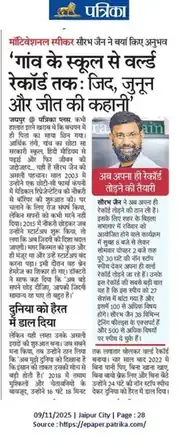
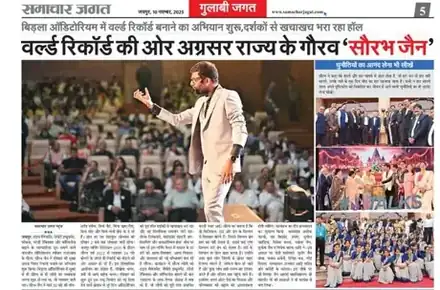
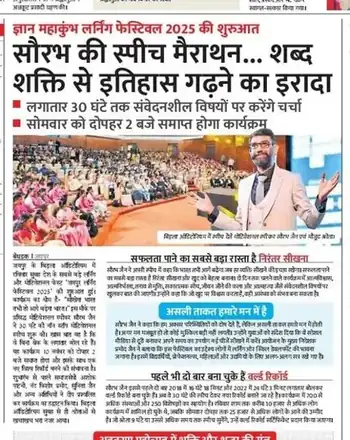
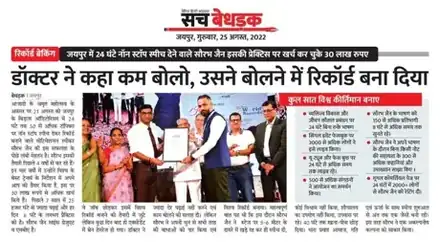
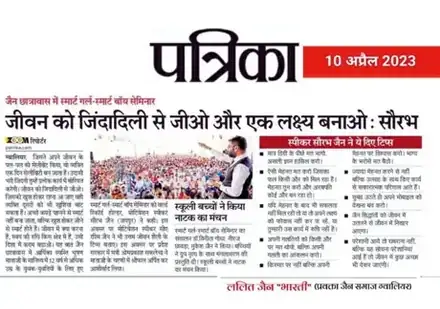
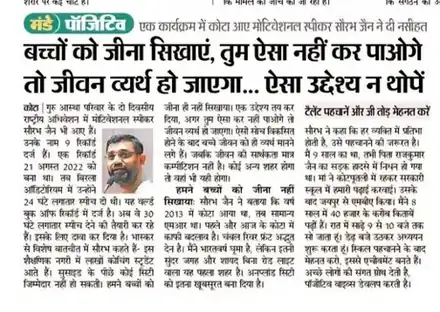
500+ media houses have covered Saurabh Jain, from Dainik Bhaskar and Rajasthan Patrika to ANI and The Print. Tap any clipping to read it.
Watch him in action
Watch the time management trainer in action: two minutes say more than any brochure.
See how he holds a room, challenges old habits and makes a single idea stick for life. Press play on any one.
Pick a problem. See the result your organisation gets.
Assured benefits
Benefits of time management training for employees: pick your problem, see the result
Pick the time problem you faced this week. See the result, the shift and how it will feel, for your people and for your organisation. In the UK's 2022 four-day week pilot, 71% of employees reported less burnout, and 56 of 61 companies kept the new way of working.
Your team's transformation: from always busy to focused and balanced
Hover over or tap each card to see the shift people experience with Saurabh Jain. When Microsoft Japan tried a focused four-day week in 2019, sales per employee rose 39.9%.
Your doubts answered, what it is worth, who it is for, why we are different, and your next step.
Before you decide
Is time management training worth it for employees? The five reasons organisations wait, answered
Most training proposals die in one meeting, on one of these five sentences. Tap yours and walk in with the answer. The decision stays yours.
1/5doubts answered
If nothing changes: Your people keep working the way they always have, busy, reactive and tired, and pass it on to every new joiner.
Time management is not a personality trait. Planning, prioritising, focusing, delegating and switching off are behaviours, and behaviours change with practice.
Proof: A meta-analysis of 158 samples (Aeon and colleagues, PLOS ONE, 2021) found time management improves job performance, and improves well-being and life satisfaction even more.
Try itCan your team already do these? Tap what is true.
If nothing changes: Unmeasured training is the first budget line cut, and the old time habits stay.
We agree the measures with your HR and L&D team upfront: a pre and post assessment, a team time audit, a 21-day logbook and a summary report for management.
Proof: Deloitte (2022) estimates poor mental health, driven largely by workplace stress, costs Indian employers about US$14 billion a year in absenteeism, presenteeism and attrition.
If nothing changes: Training that fades is the costliest kind: you pay once, then keep paying for the old habits.
Inspiration fades when practice stops. Ours continues: a 21-day logbook, weekly reviews and HR check-ins, until the new habits become the way your team works.
Proof: Hermann Ebbinghaus showed unpractised learning fades within days, and that each spaced review resets the curve.
Try itAfter one training with no review, how much is still remembered?
His classic 1885 memory data, shown for illustration.
Time management training ROI calculator: cost versus the results you will get
See what lost time costs your organisation every year: hours drained by interruptions, unproductive meetings, rework and burnout, plus sales missed through lost selling time. Time is valued at salary cost, conservatively, and revenue is credited only to sales roles, as gross profit.
Who is joining?
Use the figure from your proposal, or an estimate.
Who should join this time management and work-life balance program?
Every level loses time differently: employees to interruptions, managers to meetings and approvals, senior leaders to always-on pressure. Pick yours and see what changes.
Built for
Employees and executives
01
Sounds familiar?
“I am busy from 9 to 7, yet my own work starts only after everyone leaves.”
After the training
Calm, planned days with real focus time for real work.
32+ industries. One proven way to win back time at every level.
Pharma and healthcareMedical devices and diagnosticsHospitals and clinicsBanking and financial servicesNBFC and microfinanceInsuranceMutual funds and wealth managementStock brokingReal estateConstruction and building materialsFMCGRetail and showroomsE-commerce and D2CManufacturing and engineeringIndustrial B2BIT, SaaS and technology
Pharma and healthcareMedical devices and diagnosticsHospitals and clinicsBanking and financial servicesNBFC and microfinanceInsuranceMutual funds and wealth managementStock brokingReal estateConstruction and building materialsFMCGRetail and showroomsE-commerce and D2CManufacturing and engineeringIndustrial B2BIT, SaaS and technology
TelecomAutomobile and dealershipsConsumer durables and electronicsJewelleryTextiles and apparelEducation and ed-techHospitality and travelLogistics and supply chainSolar and renewable energyAgri-inputs and agricultureChemicals and paintsMedia and advertisingFranchise networksDirect sellingProfessional servicesStartups and SMEs
TelecomAutomobile and dealershipsConsumer durables and electronicsJewelleryTextiles and apparelEducation and ed-techHospitality and travelLogistics and supply chainSolar and renewable energyAgri-inputs and agricultureChemicals and paintsMedia and advertisingFranchise networksDirect sellingProfessional servicesStartups and SMEs
Choose your format
In person or online: choose your time management workshop format
Pick a duration and a setting. We shape the rest around your team.
Most time management seminars just inspire. Ours changes how your team works, for life.
Your people may have attended a productivity talk: inspiring on the day, forgotten by the next deadline. Here is why our change lasts, and shows up in deadlines, focus and evenings at home.
✕Typical time management seminar
VS✓Saurabh Jain's Time Management program
Approach
Typical seminarGeneric tips and famous quotes.
Saurabh's programDiagnosed with HR and L&D first, then practised on your team's real calendars and workload.
Practice
Typical seminarListen, clap, go home.
Saurabh's programSimulations, calendar challenges, role plays and personal commitments, again and again.
Results
Typical seminarFeedback forms, forgotten by Monday.
Saurabh's programPre and post assessment, personal time audit, 21-day logbook and a report for HR.
Who leads it
Typical seminarA speaker with a slide deck.
Saurabh's programA master trainer with 2,500+ trainings and 10 World Records.
What you get
Typical seminarA good day that fades.
Saurabh's programA focused, balanced team that delivers on time and goes home on time.
The real question
It is not "Can we afford time management training for our team?" It is "Can we afford another year of a team that is always busy, always behind and always on?"
Freediscovery call1 dayto your customised proposal
Time management training in Jaipur for corporates: frequently asked questions
Who is the best time management and work-life balance trainer in Jaipur, India?
Saurabh Jain is a Jaipur-based time management and work-life balance trainer, corporate soft skills trainer and motivational speaker with 23+ years of experience, 2,500+ trainings across 32+ industries, 200+ awards and 10 World Records, including a 30-hour non-stop speech delivered without notes. He founded EnactraX, Bharat's No. 1 Soft Skills Training Centre, and the Jaipur Learning Festival. His program helps teams win back time in ten steps: priorities, planning, deep work, beating procrastination, taming meetings and email, delegation and saying no, energy management, burnout prevention, work-life boundaries and lasting habits.
What does your time management training for employees cover?
Ten topics, in sequence: priorities that matter (Eisenhower Matrix and 80/20); goal setting and smart planning; deep work and focus; beating procrastination; taming meetings, email and digital distractions; delegation and the art of saying no; energy management; stress control and burnout prevention; work-life boundaries and recovery; and habits, rituals and the weekly review. Each topic is experienced through games and simulations, then practised on your team's real calendar and workload, and we shape the mix after a free discovery call.
How do you work with our HR and L&D team?
We start with a discovery call with your HR, L&D or business head, run a short training needs analysis and a team time-audit survey, and share a customised proposal within one working day, aligned with your competency framework and well-being goals. After the program, HR receives a pre and post assessment summary, attendance and feedback reports, and a certificate for every participant.
Who should attend from our organisation?
Employees and executives, managers and team leads, senior leaders and founders, sales and field teams, and IT, operations and hybrid teams. We recommend the right mix and batch size on the free discovery call.
Which formats, where, and what does it cost?
Half day, full day, a few days, or regular weekly or monthly sessions: in person at your office, a hotel, resort or offsite venue in Jaipur, across Rajasthan and India and abroad, or live online in any time zone, in English, Hindi or both. The investment depends on duration, format, number of participants and customisation, so every organisation receives a customised proposal within one working day of the discovery call.
How is impact measured? Is there a certificate?
Every participant completes a pre and post time-management assessment and a personal time audit, practises with a 21-day focus and balance logbook, receives a certificate and a workbook, and leaves with a signed commitment and a 90-day action plan. Your HR team receives a summary of the change, and we agree business measures such as meeting hours, deadlines met, overtime, leave usage and attrition with you upfront.
Is work-life balance training only about working fewer hours?
No. It is about getting more of the right work done in the hours you already have, protecting focus and energy, and recovering properly, so people perform at their best at work and still have time and energy for family and health.
How is this different from a motivational seminar or a productivity app?
A seminar changes how people feel for a day, and an app only works if the habits behind it exist. This program changes how your team plans, focuses and switches off, through diagnosis, simulations, practice on real calendars, personal commitments, a 21-day logbook and HR follow-up, until the new habits stick.
Is the training available in Hindi and online?
Yes. Saurabh Jain trains in English, Hindi or a mix of both, in person in Jaipur, across Rajasthan and India and abroad, or live online in any time zone.
Can individuals join, or is it only for organisations?
This program is designed for organisations and their teams. If you are an individual, choose 'Just me (individual)' in the enquiry form and Saurabh Jain's team will guide you to the right option.
Saurabh JainBest time management and work-life balance trainer in Jaipur and 10-time World Record holder
Priorities. Focus. Energy. Balance.
Invite the best time management and work-life balance trainer in Jaipur to train your team
For HR, L&D and business heads: talk to Saurabh Jain's team about a more focused, productive and balanced workforce. Free, with no obligation, and a reply within 24 hours.
What happens next
1
You send the enquiry
Takes less than a minute.
2
Free discovery call
We understand your team, where time is lost, and your business and well-being goals.
3
Your customised proposal
Within one working day, aligned with your competency framework and L&D calendar.
4
Ready for your L&D records
Needs analysis, pre and post assessment report, attendance and a certificate for every participant.
200+Awards
2500+Trainings
10World Records
23+Years
Bonus episode · The Victory
Celebrate the win. Enjoy a focused, balanced team for life.
Every great series ends with a celebration. With Saurabh Jain, yours starts on the last day of the program and never really ends.
Day 1
The celebration
Certificates, a final time challenge won together, and a commitment every participant has signed.
Day 21
The new habit
The logbook is complete. Planning tomorrow, protecting focus and switching off at night now happen without thinking.
Year 1
The new culture
Shorter meetings, deadlines met calmly, less overtime and good people who stay.
For life
The lifelong payoff
Every new joiner learns that here, we work with focus and go home on time. Better time habits keep paying, year after year.
“You cannot add hours to the day. You can add focus, energy and life to every hour.”