
Great ideas, in a voice nobody remembers
Shallow breath, rushed words and a flat or shaky tone make strong content sound unsure. Duke's Mayew and colleagues found CEOs with deeper voices ran larger firms and earned about $187,000 more a year.
Corporate theatre training for teams whose best ideas get lost in flat voices, nervous bodies, frozen replies and forgettable presentations.
Be honest for 60 seconds. Tap every moment you have seen in your team this quarter. Each one is an untrained skill, not a personality flaw, and skills can be trained.
Grammarly and The Harris Poll estimate poor communication costs U.S. businesses about $1.2 trillion a year. Most of it is not what people say, but how it lands. Tap a gap to find yours.
Shallow breath, rushed words and a flat or shaky tone make strong content sound unsure. Duke's Mayew and colleagues found CEOs with deeper voices ran larger firms and earned about $187,000 more a year.
Folded arms, frozen hands and a shrinking stance leak doubt to every listener. Harvard's Chia-Jung Tsay found people picked music-competition winners better from silent video than from the sound itself.
A tough question, a broken slide or a client's 'no', and the mind goes blank. At CES 2014, film director Michael Bay walked off Samsung's stage when his teleprompter failed.
People wait for their turn instead of listening, so objections, signals and ideas are missed. CRICO Strategies linked communication failures to 1,744 deaths and $1.7 billion in U.S. malpractice costs over five years.
Tone, subtext and timing send a message the words never meant. In 1991, Gerald Ratner joked about his own products in one speech, and about £500 million was wiped off his company's value.
Video calls, webinars and recorded messages flatten energy, eye contact and expression. In the 1960 TV debate, a pale, sweating Nixon lost the screen to a calm, camera-ready Kennedy.
In Dwyer and Davidson's 2012 survey, people picked public speaking as a fear more often than death. Every pitch delivered in fear, every meeting nobody remembers and every client call that falls flat costs twice: once in the result, and once in the confidence that never grew.
Pick the situations on the left to see your score.
moments where delivery, not content, decided the outcome.
Rate 12 everyday stage moments, see your Stage Presence Score today, and what it becomes after the training.
The training takes days. A team that owns every room pays back in every meeting. Start before the next pitch, town hall or launch.
Stop the loss: invite SaurabhFound your presence gap? Close it before the next pitch, review or launch.
Most presentation workshops leave people with tips on a slide and the same nerves on Monday. Presence changes only when breath, body and voice are rehearsed until they become habit. Here is our journey, from the first call with your HR or L&D team to a team that owns every room.
We understand your team, the moments that matter most to them and what has been tried before, and share exactly how we work: the brief, the recordings we need and the timelines. No assumptions on either side.
What you get: A clear brief, and a coach who knows your team before he walks in.
Short recorded talks, a quick survey and a few honest conversations show where each person loses the room: breath, body, nerves, listening or intention. It is rarely 'lack of confidence'. More often it is an untrained skill.
What you get: The real gap named, before any time or budget is spent.
We shape the skills, theatre games, language mix, duration and format for your people. Sales teams pitching weekly, leaders facing town halls and freshers facing clients need different rehearsals.
What you get: A program built for your team, not a recycled syllabus.
Every game, scene and exercise is built from your team's real pitches, reviews, client calls and town halls, so every hour on the floor moves them towards the result.
What you get: New habits rehearsed in the room, not tips for 'later'.
Each participant picks the two skills that matter most and a 5-minute daily drill. Anders Ericsson's research showed experts are built by deliberate practice with feedback, not by experience alone.
What you get: Clear drills, clear owners and no more 'I'll work on it someday'.
We help people apply the drills in real meetings, pitches and calls, with buddy feedback and short challenges set by their managers.
What you get: Skills used at work, not stuck in a workbook.
Short recorded talks in week one and week six show the shift in voice, body and presence, and catch slips before old habits return.
What you get: Progress you can see on screen, and gaps caught early.
Deeper programs such as public speaking, leadership, sales, negotiation and team building, exactly when your team is ready for the next stage.
What you get: A team that keeps growing as fast as its ambitions.
Breath, pause and presence become 'how we speak here'. Ronald Reagan's years on stage and screen helped make him 'The Great Communicator'.
What you get: The result you invested in: confident people, persuasive messages and a stronger brand.
The workshop floor is one step out of nine. The other eight are why the results last.
Telling a nervous speaker to 'just be confident' works as well as telling a tense actor to 'just relax'. Stanislavski taught actors to fix what sits underneath: breath, body and intention. Pick the problem your team faces every week and see what changes when it is fixed at the root.
In Ambady and Rosenthal's thin-slice study, strangers who watched just 30 seconds of silent classroom video predicted teachers' end-of-term ratings. Your team is judged in seconds, before the first slide. Nine skills, in sequence, each closing a gap your team lives with every day. Tap the wheel.
Shallow breath and a tight throat make good ideas sound unsure, rushed or monotone.
Proven: All India Radio once rejected Amitabh Bachchan's voice; trained and used with intent, it became India's most recognised baritone.
Folded arms, frozen hands and nervous pacing leak doubt before a word is spoken.
Proven: In wartime Britain, Rudolf Laban and F.C. Lawrence used effort analysis in factories to help workers move with less strain and waste.
A tough question, a broken slide or a client's 'no' makes people freeze or ramble.
Proven: Martin Luther King Jr. left his prepared text when Mahalia Jackson called, 'Tell them about the dream'; the improvised part became history.
People wait for their turn to talk, so objections, signals and ideas are missed.
Proven: Princeton's Stephens, Silbert and Hasson found a listener's brain syncs with the speaker's, and the stronger the sync, the better the understanding.
Right words, wrong tone: the message lands cold, defensive or fake.
Proven: During the 2010 oil spill, BP's Tony Hayward said 'I'd like my life back'; the words cost him public trust, and soon the top job.
Rushed delivery and filler words bury the key message under noise.
Proven: Edward Everett spoke for two hours at Gettysburg; Lincoln's 272 words took about two minutes and became immortal.
Eyes on slides, notes or the floor, and the audience quietly drifts away.
Proven: Yale's Joy Hirsch found live eye-to-eye contact engages social and language areas of the brain that a picture of eyes does not.
A blank or tense face contradicts the words, so people trust the face.
Proven: Paul Ekman, whose Facial Action Coding System maps 44 facial muscle movements, advised Pixar on the emotions of Inside Out.
People never see themselves present, so the same habits repeat for years.
Proven: Steve Jobs rehearsed the 2007 iPhone launch for days, run-through after run-through, until it looked effortless.
By Friday, most of Monday's training is forgotten. What stays is what you rehearsed and performed. So every skill is first felt through a theatre game, then rehearsed in a real scene, then performed at real work. Tap each step and try it.
Warm up, play, rehearse, perform, applaud. Every session rises like a wave: laughter and theatre games first, then brave rehearsals, then a performance the whole room applauds.
Feel the 9 stage skills in action with your own pitches, your real meetings and your real audiences.
Saurabh Jain was a shy student who would rather hide than face the stage. He trained his breath, voice, body and nerves until he set 10 World Records in public speaking, including a 30-hour non-stop speech with no notes. He founded EnactraX, Bharat's No. 1 Soft Skills Training Centre, and the Jaipur Learning Festival, and has led 2,500+ trainings. He does not teach presence from a textbook. He teaches it from 23+ years on live stages.
A venture of Pragya. Bharat’s No. 1 Soft Skills Training Centre.
“Learning & Motivation का महाकुम्भ”, home of the 30-hour non-stop speech.
Each one could have ended the story. Tap a card and see what happened next.
जिन्दगी मैं फिर तैयार हूँ, तू कोई कमी मत छोडना मेरे मजे लेने में,क्योंकि मैं कोई कसर नहीं छोड़ने वाला तेरे मजे लेने में.
"Life, I am ready again. Don't hold back in testing me, because I won't hold back in living you."
Saurabh JainHis core belief: presence is not a gift some people are born with. It is built step by step, with breath, body and rehearsal, and that is exactly what he builds with your team.

“Training is not just my profession. It's my purpose, my passion and my profession.”
You have sat through enough presentation training that sounded great in the hall and was gone by the next meeting. This is what he does differently.
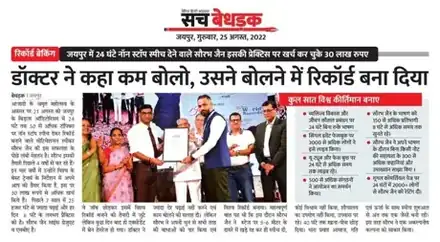
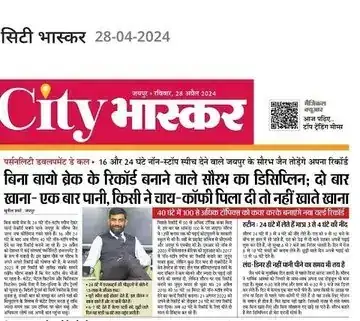
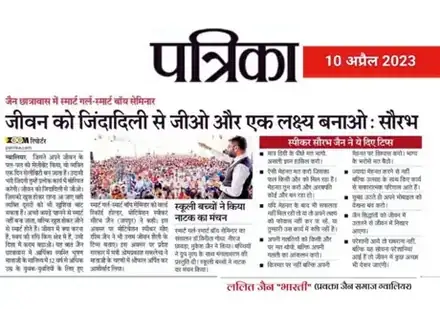
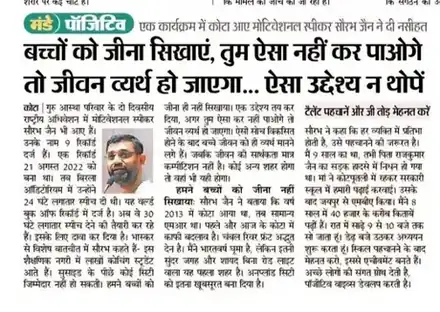
500+ media houses have covered Saurabh Jain, from Dainik Bhaskar and Rajasthan Patrika to ANI and The Print. Tap any clipping to read it.
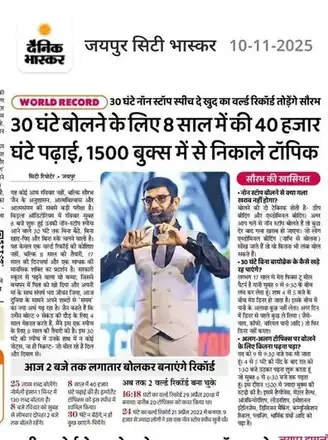
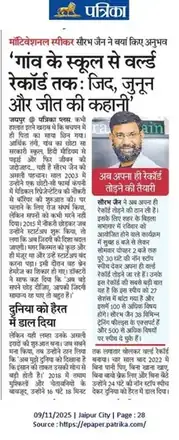

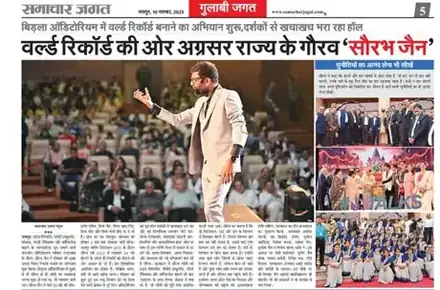
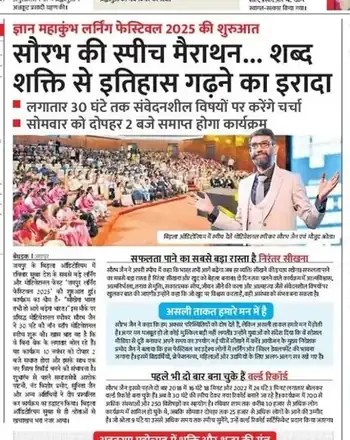

See how he holds a room with voice, pause and presence, and makes a single message stick. Press play on any one.
Pick the problem your team faced this week. See the result, the shift and how it will feel, for your people and your organisation.
Hover over or tap each card to see the shift teams experience with Saurabh Jain.
Most training proposals die in one meeting, on one of these five sentences. Tap yours and walk in with the answer. The decision stays yours.
If nothing changes: 'Fine' stays the ceiling, while rival teams learn to be memorable.
Good presenters can become great ones. Theatre training sharpens what already works and fixes the habits nobody ever tells people about.
Proof: Warren Buffett was terrified of public speaking; he took a Dale Carnegie course and still keeps its certificate on his office wall.
If nothing changes: Lost pitches, flat town halls and forgotten messages keep costing money no report ever shows.
We agree the measures with you upfront: a pre and post presence score, before-and-after video, and the pitch, meeting and feedback numbers that matter to you.
Proof: A meta-analysis by Fukkink and colleagues found video feedback consistently improved professionals' communication skills.
If nothing changes: Your team already spends hours a week in meetings and calls that could land faster and better.
A half-day workshop, a full-day intensive or a 6-week program, then about 5 minutes a day of practice. Every exercise uses your real meetings and pitches, so it is work, not time away from work.
Proof: In a Stanford trial led by Balban (2023), just 5 minutes a day of slow, controlled breathing improved mood and lowered anxiety.
If nothing changes: Training that fades is the costliest kind: you pay once, then keep paying for the old habits.
Skills fade when practice stops. Ours continues: a personal rehearsal plan, buddy feedback and before-and-after video, until the new way of speaking becomes your team's way.
Proof: In Olivero's study of public-sector managers, training alone raised productivity by 22%; training followed by coaching raised it by 88%.
If nothing changes: Every quarter of waiting, another round of pitches, reviews and town halls runs on old habits.
Next quarter rarely arrives calmer. Every big stage your team faces before then is a stage they could have owned.
Proof: Kodak's own engineer built the first digital camera in 1975; it was shelved with 'don't tell anyone', and Kodak filed for bankruptcy in 2012.
See what weak delivery costs your team every year: hours lost to unclear meetings and re-explaining, pitches lost to forgettable presentations, and customers lost after poor conversations. Time is valued at salary cost, conservatively, and revenue is credited only as gross profit.
Every team loses the room in a different place: leaders in town halls, sales teams in pitches, freshers in front of clients. Pick yours and see what changes.
“I know my content cold, but my town halls still feel flat.”
A voice, pause and presence that make people remember and act.
“We lose pitches to rivals with weaker products and stronger presentations.”
Pitches clients remember, and calm answers to every objection.
“My team nods in meetings, then does something else.”
Meetings where people listen, understand and act.
“Learners are on their phones by the second hour.”
Sessions with energy, movement and stories that hold any room.
“I freeze when a senior or a customer asks something unexpected.”
Calm, clear replies and a confident first impression, every time.
32+ industries. One proven way to build confident, magnetic teams.
Pick a duration and a setting. We shape the rest around your team, your audiences and your goals.
Your team may have attended presentation training before: useful slides, forgotten by the next meeting. Here is why our change lasts, and shows up in pitches, meetings and on camera.
It is not "Can we afford theatre training?"
It is "Can we afford another year of great ideas delivered forgettably?"
Saurabh Jain is a Jaipur-based theatre and public speaking coach, corporate trainer and 10-time World Record holder with 23+ years of experience, 2,500+ trainings across 32+ industries and 200+ awards, including a 30-hour non-stop speech with no notes. He founded EnactraX, Bharat's No. 1 Soft Skills Training Centre, and the Jaipur Learning Festival. His corporate theatre training covers nine stage skills: vocal control and diaphragmatic breathwork, Laban movement analysis, improv 'Yes, and...', active listening, subtext and emotional intention, the deliberate pause, eye contact, micro-expressions and on-camera review.
Theatre training, also called applied or corporate theatre, uses the tools actors train with, such as breath, voice, movement, improvisation and rehearsal, to build workplace skills like presenting, persuading, listening and executive presence. Instead of tips on slides, people practise in games and real workplace scenes until the new behaviour becomes a habit.
Nine stage skills, in sequence: vocal control and diaphragmatic breathwork; Laban movement analysis and physical characterization; spontaneous thinking via improv 'Yes, and...'; active listening and reactive stage presence; subtext and emotional intention in delivery; the art of the deliberate pause and pacing; eye contact and audience connection; micro-expressions and facial articulation; and performance analysis and on-camera review. Stage-fright control is built into the voice and breath skill, and storytelling into the subtext skill. We shape the mix after a free discovery call.
No. Nobody is asked to become an actor or perform a play. The exercises are short, playful and built around real workplace moments such as pitches, reviews, client calls and town halls, so even the shyest participants take part comfortably.
Send the enquiry form on this page or WhatsApp +91 70731 88666 with your preferred dates, venue, group size and goals. We hold a free discovery call, confirm availability and send a customised proposal within one working day, along with Saurabh Jain's trainer profile for your internal approvals.
Leaders and CXOs, sales and client-facing teams, managers and team leads, trainers, faculty and HR and L&D teams, and young professionals and front-line teams. We recommend the right mix and format on the free discovery call.
A half-day workshop, a full-day intensive, a 6-week performance program or one-on-one coaching: in person at your office, a hotel or an offsite in Jaipur, across Rajasthan and India and abroad, or live online in any time zone, in English, Hindi or both. The investment depends on duration, format, group size, travel and customisation, so every organisation receives a customised proposal within one working day of the discovery call.
Yes. It draws on research in voice science, breathing and stress physiology, nonverbal communication, improvisation, listening and neural coupling, facial expression and video feedback, explained simply and applied to your team, never as theory for its own sake.
Every participant completes a pre and post presence score and records a short talk before and after; longer formats include a workbook, a rehearsal plan and a certificate. We agree business measures with you upfront, such as pitch win rates, meeting feedback, customer ratings or town-hall engagement.
Yes. Choose 'Just me (individual)' in the enquiry form and Saurabh Jain's team will guide you to one-on-one coaching or the right open program.
Tell us about your team and the stages they face. A free discovery call, no obligation, and a reply within 24 hours.
Takes less than a minute.
We understand your team, the moments that matter and the result you want.
Within one working day, shaped to your team.
Every great show ends in applause. With Saurabh Jain, yours starts on the first day of training and keeps paying back for years.
Your team's presence score, each person's top two gaps named and a first video recorded.
Steady voices, open bodies, calm replies, and before-and-after videos that show the shift.
More pitches won, livelier meetings, stronger client trust and leaders people want to follow.
Confidence that carries into every interview, stage, camera and conversation, at work and at home.
“Confidence is not a gift you are born with. It is a skill you rehearse until the stage feels like home.”