
Small goals, small results
When targets are set to be ‘safe’, the team never finds out what it can do. Across hundreds of studies, specific, hard goals beat ‘do your best’ in about 90% of cases (Locke and Latham, 2002).
For HR and L&D heads whose people are talented, yet play small, doubt themselves, procrastinate and freeze when things change.
Be honest for 60 seconds. Tap every moment you have seen this month. Each one is a mindset pattern, not a people problem, and patterns can be rewired.
Your people have the skills. Yet they play small, procrastinate and freeze when things change. Six mindset gaps cause it. Tap a stage to find yours.
When targets are set to be ‘safe’, the team never finds out what it can do. Across hundreds of studies, specific, hard goals beat ‘do your best’ in about 90% of cases (Locke and Latham, 2002).
Treat ability as fixed and you lose ideas, risk-taking and ownership. In growth-mindset companies, staff were 34% likelier to feel ownership and 65% likelier to say risk-taking is supported (Harvard Business Review, 2014).
Capable people decline stretch roles and stay silent, and you lose tomorrow’s leaders today. An estimated 70% of people feel like an impostor at some point (Sakulku and Alexander, 2011).
Seminar highs fade by Monday, and disengagement quietly drains results. Gallup found only 23% of employees worldwide are engaged, costing the global economy $8.9 trillion a year (2024).
New systems, AI and restructures meet resistance, and change dies halfway. McKinsey research has long found that about 70% of transformations fall short, largely because of people’s mindsets and behaviours.
Phones, pings and ‘quick’ meetings shred focus, so deep work never happens. UC Irvine’s Gloria Mark found attention on a screen now lasts about 47 seconds before people switch.
Every safe target, avoided challenge or postponed task costs twice: once in the result, and once in your team's belief in itself.
Pick the situations on the left to see your score.
moments where mindset, not skill, decided the outcome.
Rate 12 everyday mindset moments, see your Mindset Strength Score today, and what it becomes after the program.
The program takes days. A winning mindset pays back in every target. Start before the next target cycle, launch or restructure.
Stop the loss: book a mindset callFound your mindset gap? Close it before the next target cycle, launch or restructure.
Most motivational seminars inspire on the day and are forgotten by the next target review. A mindset is rewired like a muscle, through small daily practice at real work. Here is our journey, from the first conversation with your HR and L&D team to a winning culture that stays.
We meet your HR, L&D and business heads to understand your people, their targets, the culture you want and what has been tried before, and give you full clarity on how we work. No assumptions on either side.
What you get: A shared, honest picture of how your team thinks under pressure today.
A mindset pulse survey and real workplace situations show the real gap. It is rarely 'lazy people'. More often it is fear of failure, self-doubt, unclear goals or daily habits that drain focus.
What you get: The right problem, before any time or budget is spent.
We shape the right mix of the 16 mindset topics, activities, duration and format for each group. Sales teams, new joiners and senior leaders need different programs.
What you get: A program designed for your team, not a ready-made pep talk.
Every game, case and activity is linked to your real situations: targets, rejections, change announcements, deadlines and setbacks, so each minute in the room moves your team towards the result.
What you get: A mindset practised on the moments your people actually face.
Each participant writes a Golden Vision Letter and a personal commitment: the goal they will chase, the habits they will build and the self-talk they will use. Self-determination research shows chosen goals outlast imposed ones.
What you get: People who own the change, because they chose it.
We help people apply their commitments in the next target review, client meeting or tough week, and clear roadblocks on the ground.
What you get: A mindset used at work, not left at the venue.
A 21-day mindset practice logbook, manager check-ins and HR feedback track progress and adjust the plan in time.
What you get: Progress you can see in numbers, and slips caught early.
Advanced levels such as mental toughness, peak performance, a leader's mindset and one-to-one coaching, exactly when your people are ready.
What you get: People who keep growing after the program.
Bold goals, a growth mindset and quick adaptation become 'how we work here', and every new joiner learns them from the person before them.
What you get: The result you invested in: champions at every desk.
Training is one step out of nine. The other eight are why your team keeps winning.
Another motivational speech treats the symptom, and the old thinking returns next quarter. Pick the mindset problem your team faces every week and see what changes when it is fixed at the root.
Champions are not born lucky. They are built. Stanford psychologist Carol Dweck’s research shows people who believe ability can grow take on harder challenges and recover faster from failure. Sixteen topics, in sequence, each closing a mindset gap your team lives with every day. Tap the wheel.
People think in 10% steps, so they never discover what a 10X result would take.
Before → afterRoger Bannister, 1954: experts called a sub-4-minute mile impossible. He ran 3:59.4, and John Landy beat it just 46 days later.
People compare themselves with the desk next to them, not with the best in the world.
Before → afterTom Brady, 2000 → 2021: picked 199th in the NFL draft, he outworked every doubt and won 7 Super Bowls, more than any single franchise.
Teams settle for ‘second best’, call it success and hold back the last 10% of effort.
ResearchCornell psychologists studied footage of Olympic medallists: bronze winners looked happier than silver winners, because silver keeps asking ‘what if?’ (Medvec, Madey and Gilovich, 1995).
Goals live in heads and slide decks, never written, felt or reviewed, so they quietly fade.
ResearchDominican University (Matthews, 2015): people who wrote their goals, shared them and sent weekly progress reports achieved 76% of them, against 43% for those who only thought about them.
One ‘no’ from a boss, client or colleague, and a good idea is dropped forever.
Before → afterKiran Mazumdar-Shaw, 1978: banks would not back a young woman starting a biotech firm in a Bengaluru garage with ₹10,000. That firm became Biocon, a global biopharma company.
Capable people play small, decline stretch roles and wait for permission, so talent stays hidden.
Before → afterVirat Kohli, England 2014 → 2018: he averaged 13.40 across 10 Test innings and later spoke openly about how low he felt. Four years on, he topped the series with 593 runs.
‘It’s impossible’ and ‘Nothing will change’ become the team’s language, and then its reality.
PsychologyMichigan psychologist Ethan Kross (2014): people who coached themselves by their own name or ‘you’ felt less anxious and gave better speeches under pressure.
People believe talent is fixed, so they avoid challenges, fear feedback and stop learning.
Before → afterMichael Jordan, 1978: left off his school’s varsity basketball team. He practised harder than anyone and went on to win 6 NBA titles.
Big visions sit far from today’s reality, and nobody maps the steps in between.
Before → afterISRO, 2019 → 2023: Chandrayaan-2’s lander crashed. ISRO studied every failure point and redesigned for failure; Chandrayaan-3 made India the first nation to land near the Moon’s south pole.
People wait to ‘feel motivated’, so work slows the moment nobody is chasing them.
NeuroscienceDopamine rises in anticipation of a reward and with signs of progress, not only at the finish line (Schultz, Science, 1997). Visible small wins keep the brain driving.
After a setback, a lost client or harsh feedback, people sink into stress, blame or quitting.
Real storyDashrath Manjhi, 1960 → 1982: after his wife could not reach a hospital in time, he cut a path through a hill with a hammer and chisel for 22 years, shrinking his village’s journey from 55 km to 15 km.
Every new system, AI tool or restructure meets resistance, and the team falls behind the market.
Before → afterKodak vs Fujifilm: as film collapsed, Kodak filed for bankruptcy in 2012. Fujifilm reinvented itself in healthcare, cosmetics and materials, and thrived.
Phones, pings and meetings eat the day, and important work is always pushed to ‘tomorrow’.
Before → afterMicrosoft Japan, 2019: a 4-day week trial with shorter meetings and fewer distractions raised sales per employee by about 40%.
Everyone looks busy clearing inboxes, while the big, needle-moving work never starts.
ResearchThe ‘mere urgency effect’ (Zhu, Yang and Hsee, Journal of Consumer Research, 2018): people picked urgent small tasks over important ones, even when the important task paid more.
Training energy fades by Monday because nothing changes in the daily routine.
Before → afterBritish Cycling, 2003 → 2012: coach Dave Brailsford chased 1% gains in daily routines. The team won 8 Olympic golds in Beijing 2008, and Bradley Wiggins became Britain’s first Tour de France winner in 2012.
Every day, news, complaints and old failures wash the brain with doubt, and nobody washes it back.
NeuroscienceCleveland Clinic (Ranganathan and colleagues, 2004): people who only imagined finger exercises gained 35% in strength, against 53% for those who trained physically.
By Friday, people forget most of what they heard on Monday. They remember what they did. So every topic is first experienced as a game or challenge, then practised on your team's real situations until it becomes the way they think. Tap each step and try it.
Experience, understand, practise, apply. Every session rises like a wave: high-energy games and challenges, balanced by quiet moments of reflection and real goals from your team's work.
Feel the 16 mindset topics in action with your own team, your real targets and your real challenges.
Saurabh Jain began his career as a medical representative and rose to MSD Rajasthan State Head, leading teams through targets, pressure and change. In June 2017, two startups collapsed on the same day. He rebuilt from a one-room institute, step by step, into EnactraX, Bharat's No. 1 Soft Skills Training Centre. After a brain haemorrhage, doctors told him he would not speak in public again. He healed, and 11 months later set his first non-stop speaking world record; he went on to speak for 30 hours without a single note. He has failed, fallen, rebuilt and won again. His own life is the winning, growth and adaptable mindset he teaches your team.
A venture of Pragya. Bharat’s No. 1 Soft Skills Training Centre.
“Learning & Motivation का महाकुम्भ”, home of the 30-hour non-stop speech.
Each one could have ended the story. Tap a card and see what happened next.
जिन्दगी मैं फिर तैयार हूँ, तू कोई कमी मत छोडना मेरे मजे लेने में,क्योंकि मैं कोई कसर नहीं छोड़ने वाला तेरे मजे लेने में."Life, I am ready again. Don't hold back in testing me, because I won't hold back in living you."
Saurabh JainHis core belief: a champion is not born. A champion is built, one thought and one habit at a time, and that is exactly what he builds with your team.

“Training is not just my profession. It's my purpose, my passion and my profession.”
Your team has sat through enough motivational talks that felt good on the day and were forgotten by Monday. This is what he does differently.
500+ media houses have covered Saurabh Jain, from Dainik Bhaskar and Rajasthan Patrika to ANI and The Print. Tap any clipping to read it.
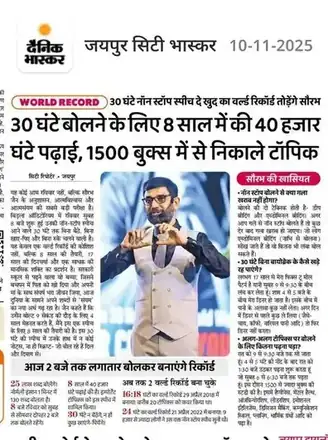
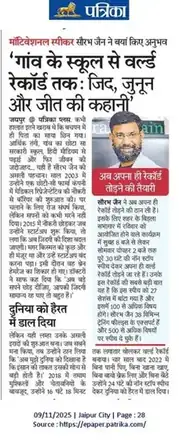

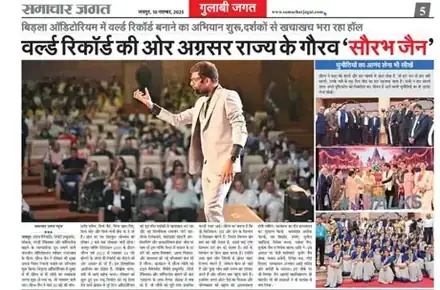
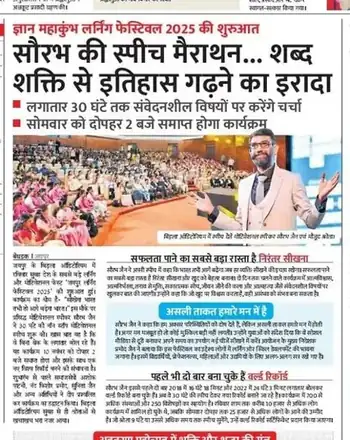
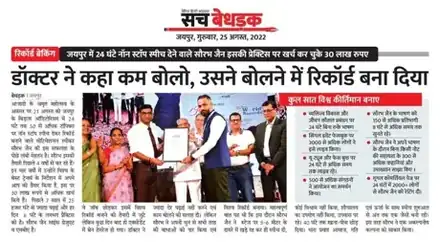
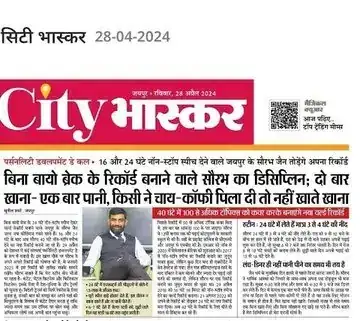
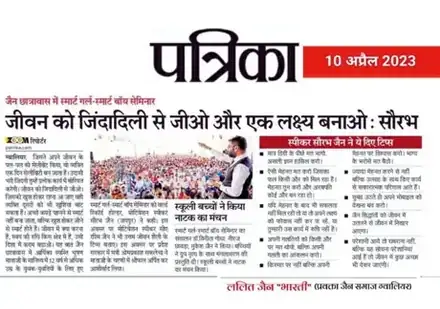
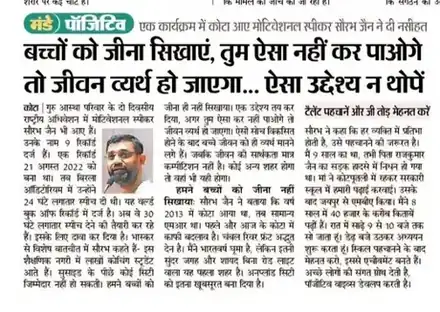
See how he holds a room, breaks limiting beliefs and makes a single idea stick for life. Press play on any one.
Pick the mindset problem you faced this week. See the result, the shift and how it will feel, for your people and for your organisation.
Hover over or tap each card to see the shift people experience with Saurabh Jain.
Most training proposals die in one meeting, on one of these five sentences. Tap yours and walk in with the answer. The decision stays yours.
If nothing changes: Your people keep the thinking habits they picked up years ago, and pass them on to every new joiner.
A mindset is not a personality you are born with. Beliefs, self-talk, focus and the response to setbacks are habits of thought, and habits change with practice.
Proof: The adult brain keeps rewiring with practice: London taxi drivers who learnt the city's 25,000 streets grew a larger hippocampus (Maguire and colleagues, PNAS, 2000).
If nothing changes: Unmeasured training is the first budget line cut, and the old thinking habits stay.
We agree the measures with your HR and L&D team upfront: a pre and post mindset assessment, manager inputs, a 21-day logbook and a summary report for management.
Proof: Gallup's meta-analysis found the most engaged business units are 23% more profitable than the least engaged.
If nothing changes: Distraction, procrastination and low energy already cost your people hours every week.
Half-day modules, staggered batches or online sessions, then about ten minutes of practice a day inside real work.
Proof: Intel's legendary CEO Andy Grove called training 'one of the highest-leverage activities a manager can perform'.
If nothing changes: Training that fades is the costliest kind: you pay once, then keep paying for the old habits.
Inspiration fades when practice stops. Ours continues: a 21-day mindset logbook, manager check-ins and HR feedback, until the new habits become the way your team thinks.
Proof: Hermann Ebbinghaus showed unpractised learning fades within days, and that each spaced review resets the curve.
If nothing changes: Every quarter of waiting, another round of targets, launches and new joiners is shaped by the old, safe thinking.
Next quarter rarely arrives quieter, and markets reward the teams that adapt first.
Proof: Nokia led the mobile phone market in 2007, adapted too slowly as smartphones arrived, and had sold its phone business by 2013.
See what a weak mindset costs your organisation every year: time lost to distraction, procrastination, low motivation and resistance to change, plus sales missed through fear of rejection. Time is valued at salary cost, conservatively, and revenue is credited only to sales roles, as gross profit.
Every level struggles differently: new joiners with self-doubt, sales teams with rejection, managers with motivation and change. Pick yours and see what changes.
“He is talented, but he never volunteers and freezes when things go wrong.”
Confident young professionals who back themselves and learn fast.
“One rejection and the whole day goes flat. Every target feels impossible.”
A team that handles rejection, aims high and wins consistently.
“I spend half my week chasing and re-motivating my team.”
Managers who build belief and self-driven teams.
“We have big plans, but the organisation thinks small and moves slowly.”
A leadership team that thinks 10X and leads change from the top.
“Every new system meets resistance, and the rollout drags for months.”
Teams that adapt quickly and stay productive through change.
32+ industries. One proven way to build a winning mindset at every desk.
Pick a duration and a setting. We shape the rest around your team.
Your team may have attended a motivational seminar: inspiring on the day, forgotten by Monday. Here is why our change lasts, and shows up in targets, retention and results.
It is not "Can we afford mindset training for our team?"
It is "Can we afford another year of a talented team that plays small?"
Saurabh Jain is a Jaipur-based mindset trainer, corporate soft skills trainer and motivational speaker with 23+ years of experience, 2,500+ trainings across 32+ industries, 200+ awards and 10 World Records, including a 30-hour non-stop speech delivered without notes. He founded EnactraX, Bharat's No. 1 Soft Skills Training Centre, and the Jaipur Learning Festival. His Winning, Growth and Adaptability Mindset Training builds 16 topics, from a 10X winning mindset, self-talk and a growth mindset to adaptability, deep focus and a daily champion protocol.
Sixteen topics, in sequence: Achieve Your Dreams 10X Faster With a Winning Mindset; Think Like a G.O.A.T.: How You Can Achieve Mind-Blowing Results; Go for the Gold: The Shocking Truth About Your Dreams and Why You’re Settling for Silver; Manifest Your Dream Future 10X Faster with the Golden Vision Letter; What to Do When Others Don’t Believe In You; How to Crush Self-Doubt; Revolutionize Your Self-Talk: Awaken Your Inner Coach to Conquer Your ‘Impossible’ Dreams; Growth Mindset: Turn ‘I Can’t’ into ‘I Can’t… Yet’; Bridging the Gap Between Your Current and Future Reality; Unlocking Your Inner Drive: Overcoming the Motivation Trap; From Pain to Power: Harnessing Your Emotions for Motivation and Success; Adaptability Quotient: Win When the Rules Change; The Productivity Powerhouse: How to Destroy Distraction and Procrastination; Making Big Moves: How to Overcome Productive Procrastination; Your Daily Protocol to G.O.A.T.ify Yourself; Your Champion Mindset Activation Technique: The Brainwash. Each topic is experienced through games and challenges, then practised on real workplace situations, and we shape the mix around your team after a free discovery call.
A growth mindset, from Stanford psychologist Carol Dweck's research, is the belief that ability grows with effort and learning, so challenges and feedback become fuel. A winning mindset adds the hunger to aim high and finish first. Adaptability is the ability to adjust quickly when the rules change. This program builds all three, because each one stalls without the others.
We start with a discovery call with your HR, L&D or business head, run a short training needs analysis and mindset survey, and share a customised proposal within one working day, aligned with your competency framework and values. After the program, HR receives a pre and post assessment summary, attendance and feedback reports, and a certificate for every participant.
New joiners and young professionals, sales and business development teams, managers and team leads, senior leaders and CXOs, and any team going through change such as a new system, AI rollout, merger or restructure. We recommend the right mix and batch size on the free discovery call.
Half day, full day, a few days, or regular weekly or monthly sessions: in person at your office, a hotel, resort or offsite venue in Jaipur, across Rajasthan and India and abroad, or live online in any time zone, in English, Hindi or both. The investment depends on duration, format, number of participants and customisation, so every organisation receives a customised proposal within one working day of the discovery call.
Every participant completes a pre and post mindset assessment, practises with a 21-day mindset logbook, receives a certificate and a workbook, and leaves with a signed Golden Vision Letter and a 90-day action plan. Your HR team receives a summary of the change, and we agree business measures such as target achievement, engagement, attrition and adoption of change with you upfront.
Yes. Carol Dweck's research at Stanford, Gallup's engagement studies, neuroscience on neuroplasticity and decades of goal-setting research by Locke and Latham all show that mindset and habits can be trained, and that they drive measurable performance. Every topic in this program is linked to research and a real before-and-after example.
A motivational seminar changes how people feel for a day. This program changes how they think and act, through diagnosis, games, role plays, a Golden Vision Letter, a 21-day practice logbook and HR follow-up, until the new habits stick.
Yes. Saurabh Jain trains in English, Hindi or a mix of both, in person in Jaipur, across Rajasthan and India and abroad, or live online in any time zone.
This program is designed for organisations and their teams. If you are an individual, choose 'Just me (individual)' in the enquiry form and Saurabh Jain's team will guide you to the right option.
For HR, L&D and business heads: talk to Saurabh Jain's team about building a winning, growth and adaptable mindset across your organisation. Free, with no obligation, and a reply within 24 hours.
Takes less than a minute.
We understand your team, where mindset breaks down, and your business goals.
Within one working day, aligned with your competency framework.
Every great series ends with a celebration. With Saurabh Jain, yours starts on the last day of the program and never really ends.
Certificates, a final champion challenge won together, and a Golden Vision Letter every person has signed.
The mindset logbook is complete. Big moves first, 'not yet' instead of 'I can't', and calm in change now happen without thinking.
Bolder targets, faster adaptation, fewer excuses and good people who stay.
Every new joiner learns from a team that thinks like champions. A winning mindset keeps paying, year after year.
“Skills decide what your team can do. Mindset decides what it will do.”