- Big-brand MBA
- 3 jobs in 4 years
“Confident and charming. Answered every question in seconds.”
Missed targets in 2 of his last 3 roles.
Last manager: “I would not rehire him.”
Left each job within 14 months.
Bad hire riskHiring and firing training for HR and hiring managers who are tired of costly bad hires, early exits and exits handled too late.
No obligation. Reply within 24 hours.
4.9 on Google · 4,250+ five-star reviewsThree candidates. One seat. Most managers decide in the first few minutes of an interview. Make your call, then see what the Law of Three and a real reference check reveal.
“Confident and charming. Answered every question in seconds.”
Missed targets in 2 of his last 3 roles.
Last manager: “I would not rehire him.”
Left each job within 14 months.
Bad hire risk“Nervous at first, then gave long, specific answers with numbers.”
Grew her territory by 38%, two years running.
Promoted twice in five years.
Last manager: “I would rehire her tomorrow.”
The real star“Sharp, knows the work, negotiates hard on every point.”
Solid results in every past role.
Accepted counter-offers twice before.
Joined only 1 of the last 3 offers he signed.
Flight risk74% of employers say they have hired the wrong person for a role. Gut feel rewards confidence. Modules 02 and 03 train your team to check proof, not polish.
A nervous interview hid five years of proven results. Module 02 teaches your whole team to see what you just saw, in every interview.
Top talent with a habit of accepting counter-offers needs a different close. Module 04 shows how to close the right people without overpaying.
Be honest for 60 seconds. Tap every moment you have seen this year. Each one is a process gap, not a bad manager, and processes can be fixed.
You keep hiring. People keep leaving, or worse, staying and underperforming. Six leaks cause it, from the job description to the exit interview. Tap a stage to find yours.
When the job is not thought through, you attract the wrong people and cannot judge the right ones. Gallup finds only about half of employees clearly know what is expected of them at work.
A pleasant chat feels like judgement, but it is guesswork. A 2022 review in the Journal of Applied Psychology (Sackett and colleagues) found structured interviews are the strongest predictor of job performance.
Polished résumés hide real histories. CareerBuilder found 58% of hiring managers have caught a lie on a résumé, and avoiding one toxic hire is worth more than double what a superstar adds (Harvard Business School, 2015).
The first weeks decide whether a hire stays. SHRM Foundation research shows up to 20% of employee turnover happens in the first 45 days, quietly wasting the whole cost of hiring.
Every month a performance problem is ignored, your best people pay for it. Gallup finds managers account for at least 70% of the variance in team engagement, so silence from the top is never neutral.
Most leaders act months after they knew. Then a careless exit hurts morale, brand and legal safety. Columbia's Joel Brockner showed fair, respectful exits keep the commitment of those who stay far higher.
Every wrong hire costs twice: once in salary, recruitment and lost output, and again in the time, morale and customers your good people lose fixing it.
Pick the situations on the left to see your score.
moments where gut feel, not a process, decided the outcome.
Rate 12 everyday hiring and people moments, see your Talent Health Score today, and what it becomes after the program.
The program takes days. One right hire, or one timely exit, pays back for years. Start before the next hiring drive, appraisal cycle or resignation.
Stop the loss: book a hiring callFound your hiring leak? Close it before the next hiring drive, appraisal cycle or resignation.
Most HR workshops sound sharp on the day and are forgotten at the next urgent vacancy. Great hiring and firing is a system, built into how your managers work every week. Here is our journey, from the first conversation with your HR, talent acquisition or leadership team to a team you would hire again.
We meet your HR, talent acquisition and leadership team to understand your roles, hiring funnel, offer drop-outs, early attrition, performance issues and past exits, and give you full clarity on how we work. No assumptions on either side.
What you get: A shared, honest picture of how your organisation hires and lets go today.
Hiring data, time to hire, 90-day attrition, exit interviews and manager conversations show the real gap. It is rarely 'no good candidates'. More often it is vague roles, unstructured interviews, unchecked references, rushed onboarding or managers who avoid hard conversations.
What you get: The right problem, before any time or budget is spent.
We shape the right mix of the nine modules, activities, duration and format for each group. Founders, HR teams, hiring managers and team leads face different hiring and firing decisions and need different programs.
What you get: A program designed for your people, not a ready-made HR talk.
Every role-play, case and tool uses your real work: your open roles, job descriptions, interview questions, offer letters and live performance cases, so each minute in the room improves a real decision.
What you get: Hiring and firing skills practised on your real roles and people.
Each participant writes a personal commitment: the hiring steps they will never skip, the conversations they will stop avoiding and the decisions they will make on time, in their own words. Self-determination research shows chosen goals outlast imposed ones.
What you get: Managers who own their people decisions, because they chose it.
We help your team apply the tools on the next vacancy, interview panel, salary negotiation, new joiner or tough performance conversation, and clear roadblocks on the ground.
What you get: Better hiring used on the job, not left at the venue.
Hiring scorecards, 30-60-90 day reviews and monthly check-ins track progress and adjust the plan in time.
What you get: Progress you can see in numbers, and bad hires caught early.
Advanced levels such as interviewer certification for panels, one-to-one coaching for leaders, retention and engagement programs and situational leadership labs, exactly when your team is ready.
What you get: Managers who keep getting sharper after the program.
Clear roles, structured interviews, strong onboarding, honest feedback and dignified exits become 'how we work here', and every new manager learns them from the culture, not only from HR.
What you get: The result you invested in: the right people, in the right roles, who stay and perform.
Training is one step out of nine. The other eight are why your hiring keeps getting better.
Another HR workshop treats the symptom, and the wrong hires keep coming. Pick the hiring or people problem your team faces and see what changes when it is fixed at the root.
Great teams are not lucky. They are hired, led and, when needed, let go with a system. CareerBuilder found 74% of employers have hired the wrong person for a role. Nine modules, in sequence, each closing a leak that drains growing teams. Tap the wheel.
A job is posted in a hurry, so the wrong people apply and nobody can say what great looks like.
ResearchA bad hire can cost up to 30% of the employee's first-year earnings (US Department of Labor estimate), and most of that is decided before the first interview.
Interviews are friendly chats, so the confident talker wins over the proven performer.
ResearchGoogle found four interviews predicted a good hire with about 86% confidence, and extra rounds added little (Laszlo Bock, Work Rules!).
Résumés are taken on trust and references are a formality, so problems arrive with the joining letter.
ResearchLeadership IQ tracked 20,000 new hires: 46% failed within 18 months, and 89% of those failed for attitude, only 11% for skills.
Great candidates are lost at the offer stage, or won by overpaying and breaking internal pay balance.
ResearchTversky and Kahneman (1974) showed the anchoring effect: the first number on the table shapes the whole negotiation.
New joiners get a laptop and a login, then sink or swim, and many quietly start looking again.
Before → afterBrandon Hall Group research for Glassdoor found strong onboarding improves new-hire retention by 82% and productivity by over 70%.
Managers lead everyone the same way, so beginners feel lost and experts feel micromanaged.
ResearchGallup found employees who get daily feedback from their manager are about 3 times more likely to be engaged than those who get it once a year.
Underperformance is ignored for months, then handled with anger or a sudden warning letter.
ResearchGallup estimates managers account for at least 70% of the variance in team engagement, so how they handle problems shapes the whole team.
Leaders keep the wrong people out of guilt, habit or fear, and the whole team pays for it.
Before → afterNetflix uses the Keeper Test: if this person told me they were leaving, would I fight hard to keep them? Decisions come early, not years late.
Exits are delayed, then done badly, hurting the person leaving, the people staying and the brand.
ResearchColumbia's Joel Brockner showed that when exits follow a fair, respectful process, the commitment of the people who stay holds up far better.
Managers forget slides by Friday. They remember the interview they ran, the offer they closed and the tough conversation they rehearsed. So every module is first experienced as a game, a mock interview or a role play, then practised on your real vacancies and real people cases. Tap each step and try it.
Experience, understand, practise, apply. Every session rises like a wave: high-energy hiring games and live mock interviews, balanced by quiet moments of reflection on the people decisions that matter most.
Feel the 9 hire-to-retire modules in action with your own vacancies, your real people cases and your real goals.

Saurabh Jain has sat on both sides of the hiring table. He started as a medical representative in 2003, rose to MSD Rajasthan State Head, and spent 12 years hiring, coaching and leading sales teams across Aristo, Aventis, Baxter and MSD. He then founded EnactraX and rallied a team of 263 people onto one platform for his 30-hour world record. He has hired stars, inherited misfits and had the hardest conversations himself, so he teaches what actually works, from the first job description to the last day.
A venture of Pragya. Bharat’s No. 1 Soft Skills Training Centre.
“Learning & Motivation का महाकुम्भ”, home of the 30-hour non-stop speech.
Each one could have ended the story. Tap a card and see what happened next.
जिन्दगी मैं फिर तैयार हूँ, तू कोई कमी मत छोडना मेरे मजे लेने में,क्योंकि मैं कोई कसर नहीं छोड़ने वाला तेरे मजे लेने में."Life, I am ready again. Don't hold back in testing me, because I won't hold back in living you."
Saurabh JainHis core belief: a great team is not luck. It is hired with care, led with clarity and, when needed, let go with dignity, and that is exactly what he builds with your managers.

“Training is not just my profession. It's my purpose, my passion and my profession.”
Your managers have sat through enough HR policy sessions that felt complete on the day and were forgotten at the next interview. This is what he does differently.
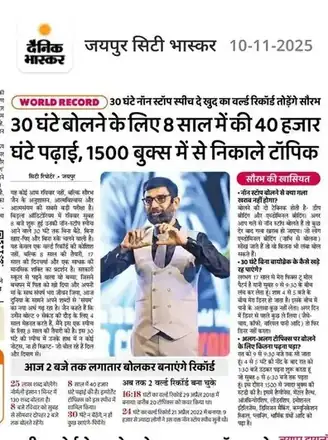
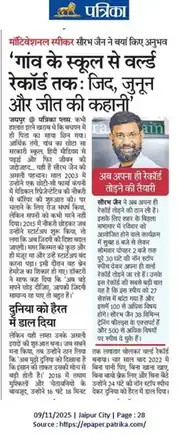
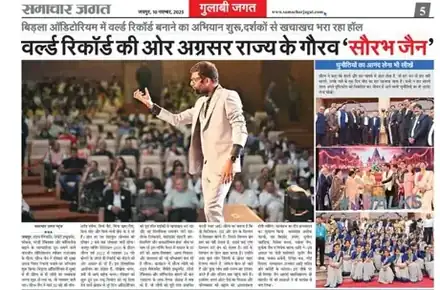
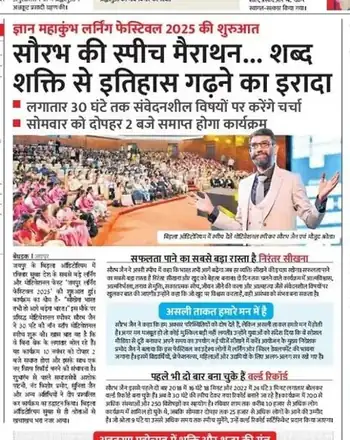
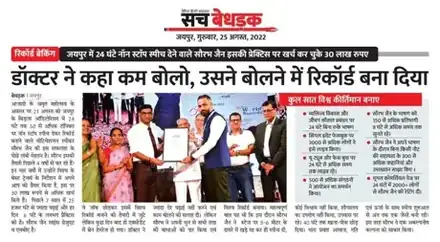
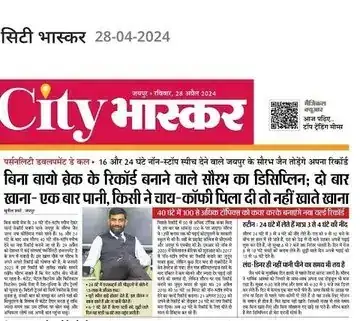
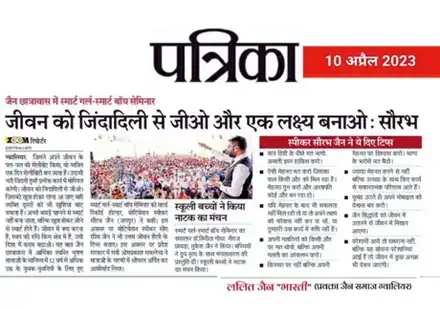
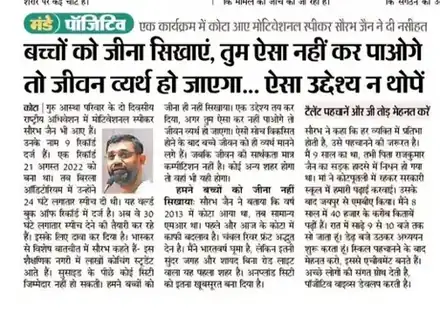
500+ media houses have covered Saurabh Jain, from Dainik Bhaskar and Rajasthan Patrika to ANI and The Print. Tap any clipping to read it.
Real words from directors, HR partners and leadership teams who brought him in. Rated 4.9 on Google by 4,250+ people.
The take-away of the sessions was useful for me to take a few decisions in a positive manner. The special session on leadership communication was brilliant, and I would like to appreciate the method and technique.
An amazing experience with a great, witty personality. Sessions full of skill, vast knowledge and very practical activities that cement and synchronise teams. As he says, “I am not an entertainer, I am a trainer.”
The entire team thoroughly enjoyed the activities. Engaging, well-structured and thoughtfully conducted, with activities, debriefs and delivery perfectly aligned with our objectives.
See how he holds a room, challenges how leaders judge people and makes a single idea stick for life. Press play on any one.
Pick the hiring or people problem you faced this quarter. See the result, the shift and how it will feel, for your managers and for your organisation.
Hover over or tap each card to see the shift HR teams and hiring managers experience with Saurabh Jain.
One slightly better interview, one honest reference call, one clearer 90-day plan. Small daily upgrades in how your managers hire and lead add up faster than any big annual fix.

Every module ends with one small daily habit, so the 1% gains start on day one.
Most training proposals die in one meeting, on one of these five sentences. Tap yours and walk in with the answer. The decision stays yours.
If nothing changes: Hiring stays a gut-feel decision, and every wrong hire costs up to 30% of that person's first-year earnings (US Department of Labor estimate).
Most managers were promoted for doing the job, not for choosing people. Defining roles, structured interviewing, reference checks and fair exits are skills, and skills grow with practice.
Proof: In a CareerBuilder survey, 74% of employers admitted they had hired the wrong person for a role, at an average cost of nearly US$15,000 per bad hire (2017).
If nothing changes: Bad hires stay invisible on the P&L, so the cost keeps repeating, role after role.
We agree the measures with you upfront: a pre and post hiring audit, quality-of-hire scores, offer acceptance, 90-day retention, time to productivity, and a summary report for management.
Proof: SHRM estimates replacing an employee can cost 6 to 9 months of that employee's salary, and Gallup puts it at one-half to two times annual salary.
If nothing changes: Your managers keep losing hours every week to re-hiring, re-training, firefighting and managing the wrong people.
Half-day modules, staggered batches or online sessions, with templates your managers use in the very next interview, so the training saves time from week one.
Proof: Google found four structured interviews predicted a good hire with about 86% confidence, and more added little: fewer, better interviews save hours (Laszlo Bock, Work Rules!).
If nothing changes: Training that fades is the costliest kind: you pay once, then keep paying for the same hiring mistakes.
Inspiration fades when practice stops. Ours continues: interview scorecards, a 30-60-90 day onboarding plan, monthly hiring reviews and check-ins, until the process becomes the way your managers work.
Proof: Hermann Ebbinghaus showed unpractised learning fades within days, and that each spaced review resets the curve.
If nothing changes: Every quarter of waiting, more roles get filled the old way, and every wrong hire stays on the payroll for months.
Hiring never waits for a quieter quarter, and up to 20% of employee turnover happens in the first 45 days (SHRM Foundation).
Proof: Leadership IQ tracked 20,000 new hires: 46% failed within 18 months, and 89% of those failed for attitude, not skills.
See what bad hires, early exits, vacant seats and delayed firing cost your organisation every year. Time is valued at salary cost, conservatively, with no guesswork on revenue.
Everyone who touches a people decision: founders approve hires, HR runs the funnel, managers interview, lead and, sometimes, let go. Pick yours and see what changes.
“I approve every senior hire, and we still end up with the wrong people in key seats.”
A leadership team that hires slowly, fires fairly and builds a bench of A-players.
“We close positions fast, but too many new joiners leave within months.”
A TA team that fills roles with people who perform and stay.
“I interview on gut feel, then live with the hire for years.”
Managers who run structured interviews and own the quality of their team.
“I can lead tasks, but I freeze when someone underperforms.”
Confident managers who coach early, correct fairly and never delay a hard call.
“We hire in a hurry, and every wrong hire costs us a whole quarter.”
A simple, repeatable hiring system that scales with the business.
32+ industries. One proven way to hire right, lead well and let go with dignity.
Pick a duration and a setting. We shape the rest around your team.
Your managers may have attended a recruitment workshop or read the HR manual: complete on paper, forgotten at the next interview. Here is why our change lasts, and shows up in quality of hire, 90-day retention, performance and clean exits.
It is not "Can we afford hiring and firing training?"
It is "Can we afford another year of bad hires, early exits and people we should have let go long ago?"
Saurabh Jain is a Jaipur-based corporate trainer, hire to retire expert and motivational speaker with 23+ years of experience, 2,500+ trainings across 32+ industries, 200+ awards and 10 World Records, including a 30-hour non-stop speech delivered without notes. He spent 12 years in pharma sales leadership, rising from medical representative to MSD Rajasthan State Head, where he hired, coached and led sales teams. He founded EnactraX, Bharat's No. 1 Soft Skills Training Centre, and the Jaipur Learning Festival.
It is a complete hire to retire training program for HR teams and hiring managers that covers the full talent lifecycle in 9 modules: job architecture and candidate sourcing; structured interviewing and the Law of Three; background verification and cultural fit screening; salary negotiation and offer closure; 30-60-90 day onboarding; situational leadership and continuous performance management; root-cause performance intervention; zero-based talent audits and offboarding decisions; and the respectful termination interview, the Zen of Firing.
Founders, CXOs and business heads, CHROs and HR heads, talent acquisition and recruitment teams, HR business partners, department heads, hiring managers and new or first-time managers. Anyone who interviews, selects, onboards, leads or exits people benefits. We recommend the right mix and batch size on the free discovery call.
The Law of Three is a simple rule that removes gut-feel bias from hiring: consider at least three good candidates, interview the shortlisted candidate at least three times, in three different settings, with at least three different interviewers, and check at least three references. It works alongside structured, behaviour-based questions, because past performance is the best predictor of future performance.
Yes. Module 9 trains managers to prepare and conduct a professional termination interview with documentation, clarity, dignity and speed, following principles of natural justice such as a clear record, a fair hearing and a consistent process. We align every exit practice with your HR policy, standing orders and legal counsel. This is management training, not legal advice.
Choose a half day, a full day, two to three days covering all 9 modules, or a monthly series. Saurabh Jain trains in English, Hindi or a mix of both, in person at your office, hotel or offsite in Jaipur, across Rajasthan and India and abroad, or live online in any time zone.
We start with a discovery call with your HR or business head, review your current job descriptions, interview process, offer drop-outs, early attrition and exit data, and then shape the modules, case studies and role plays around your real vacancies and people cases. You receive a customised proposal within one working day.
The investment depends on duration, format, number of participants and customisation, so every organisation receives a tailored proposal. For context, the US Department of Labor estimates a bad hire can cost up to 30% of first-year earnings, and SHRM estimates replacing an employee costs 6 to 9 months of salary. Avoiding even one wrong hire usually pays for the program. Try the ROI calculator on this page with your own numbers.
We agree the measures with you upfront: a pre and post hiring audit, quality-of-hire scores, offer acceptance rate, 90-day retention, time to productivity, manager confidence in performance conversations and exit process quality. You receive a summary report for management and a certificate for every participant.
A job scorecard template, a structured behavioural interview kit, a reference-check script, an offer negotiation plan, a 30-60-90 day onboarding plan, a situational leadership guide, a performance improvement plan (PIP) framework, a zero-based talent audit sheet and a fair termination checklist, plus a workbook and a certificate.
Yes. Saurabh Jain is based in Jaipur, Rajasthan, and trains HR and leadership teams across India, including Delhi NCR, Mumbai, Ahmedabad, Bengaluru, Indore and Udaipur, and abroad, in person or live online.
The program is designed for organisations and teams. If you are an individual, choose 'Just me (individual)' in the enquiry form and Saurabh Jain's team will guide you to the right option, including one-to-one coaching on hiring and leadership.
For HR, talent acquisition and business heads: talk to Saurabh Jain's team about building a team you would hire again. Free, with no obligation, and a reply within 24 hours.
Takes less than a minute.
We understand your roles, where hiring is leaking, and your goals.
Within one working day, built around your people.
Every great series ends with a celebration. With Saurabh Jain, yours starts on the last day of the program and never really ends.
Certificates, a final team celebration and a personal hiring commitment every manager has signed.
The job scorecard, the structured interview and the three reference calls now happen before every offer, without thinking.
Better hires, faster onboarding, fewer early exits, problems corrected early and stars who stay.
A team built on the right people. Every right hire and every respectful exit keeps paying back, year after year.
“We don't fix the vastu of homes. We fix the vastu of minds.”