Clients judge your whole company by one person's grooming and tone
Princeton researchers found people judge whether a face looks trustworthy in about a tenth of a second (Willis and Todorov, 2006). A crumpled shirt or a curt hello speaks first.
One late arrival, one loud call, one public put-down. Small slips quietly cost you clients, trust and good people. We turn them into professional habits your team lives every day.
Free discovery call. No obligation. Reply within 2 working hours.

Saurabh Jain
10 World Records · 2,500+ trainings · 23+ years · 41 domains





Tap every room to inspect it. Your team walks past these slips every single day.
Be honest for 60 seconds. Tap every moment you have seen this quarter. Most bad behaviour never reaches HR as a complaint; it leaks out as lost clients, quiet resignations and slow work.
Chhoti aadatein, bada nuksaan.Small habits, big losses.
It is rarely a lack of skill. Your people are capable and willing. The leak is in everyday behaviour: how they show up, share space, use time, talk about others, speak to each other and handle mistakes. Tap a stage to find yours.
Princeton researchers found people judge whether a face looks trustworthy in about a tenth of a second (Willis and Todorov, 2006). A crumpled shirt or a curt hello speaks first.
One interruption costs far more than a minute: UC Irvine's Gloria Mark found people take about 23 minutes to fully return to an interrupted task.
In Steven Rogelberg's experiments, meetings that began just 10 minutes late produced fewer ideas and lower-quality solutions (Journal of Organizational Behavior, 2018).
People, not systems, are the weak link: the human element was involved in 74% of the breaches studied in Verizon's 2023 Data Breach Investigations Report.
In Christine Porath's survey of nearly 20,000 employees, those who felt respected by their leaders reported 89% greater job enjoyment and 56% better health (HBR, 2014).
Blame is contagious: people who simply read about someone blaming others became more likely to blame others for their own failures (Fast and Tiedens, 2010).
Bad behaviour never stays small. It costs you twice: once in lost clients, wasted hours and conflict, and again in the good people who quietly leave. MIT Sloan found a toxic culture predicts attrition 10.4 times more strongly than pay (Sull, 2022).
Pick the situations on the left to see your score.
awkward moments handled with old habits, not professional skill.
Rate 12 everyday work moments, see your Team Etiquette Score today, and what it becomes after the program.
The program takes days. A damaged reputation can take years to repair. Start before another quarter of the same old habits.
Seal the leaks: invite Saurabh
Culture is not what you write on the wall. It is what you allow in the corridor.
Saurabh Jain
Found your behaviour leak? Seal it before another month of bad habits turns into lost clients.
One lecture on manners cannot undo years of habit. Real change comes from small daily behaviours, practised until they are automatic. Here is our journey, from the first conversation to a team that holds its own standards.
We learn about your people, roles, client touchpoints and culture, and give you full clarity on how we work. No assumptions on either side.
What you get: A shared, honest picture of your team's behaviour today.
An anonymous behaviour pulse, conversations with managers and a look at complaints, client feedback and exit interviews. The real leak is often not the one first named.
What you get: The right problem, before anyone spends on a solution.
We pick the topics that fit your culture, your roles and your budget, from a half-day etiquette refresher to the full 12-topic program.
What you get: A program designed for your people, not borrowed.
Every role-play, case and mirror moment targets the leak we found, using your real situations: client visits, team meetings, the pantry and the group chat.
What you get: Learning aimed precisely at your team's behaviour gaps.
Participants agree on what must change and commit to it in their own words. Self-determination research shows chosen goals outlast imposed ones.
What you get: People who own the change, because they chose it.
We stay with your team as they practise the new habits at their desks, in meetings, with clients and in group chats.
What you get: Standards that become habits, not circulars.
Regular check-ins on behaviour scores and manager observations catch what is slipping and adjust the plan in time, the way the US Army's after-action reviews keep units improving.
What you get: Progress you can see, and problems caught early.
As new situations appear, from new joiners to hybrid work and global clients, we facilitate the next learning exactly when your team needs it.
What you get: A team that keeps growing stronger after the program.
A respectful culture takes root. People arrive on time, disagree without disrespect, own their mistakes, and every new joiner learns it from them.
What you get: The result you invested in: a team clients and colleagues respect.
Training is one step out of nine. The other eight are why the results last.
Warning letters and dress-code circulars treat the symptom; the behaviour is back next week. Behaviour changes only when people see why it matters to them. Pick your team's problem and see what changes when it is fixed at the root.
Professionalism is not a personality trait. It is a set of habits, built behaviour by behaviour. Twelve topics in seven sections take your people from how they show up to how they own their mistakes. Each one seals a leak from episode 2. Tap the wheel.
Body odour, untidy clothes or casual dress at a client meeting, and nobody knows how to raise it.
The science: People wearing a white coat they were told was a doctor's made about half as many errors on an attention test (Adam and Galinsky, Journal of Experimental Social Psychology, 2012). What you wear changes how you work.
The pantry sink, the washroom and the meeting room are always 'someone else's job'.
The science: In Dutch field experiments, 69% of people littered beside a wall covered in graffiti, against 33% beside a clean wall (Keizer, Science, 2008). Mess quietly gives everyone permission.
Speakerphone calls, loud laughter and ringtones break the focus of everyone around.
The science: Overhearing one side of a phone call distracts the brain more than a full conversation, because it keeps guessing the missing half (Emberson, Psychological Science, 2010).
Meetings start ten minutes late, and the people who came on time pay for it.
Before and after: In 2017 a Japanese rail operator publicly apologised because a train left 20 seconds early. That is what a culture of respect for time looks like from the outside.
Rumours travel faster than official news, and the team quietly splits into camps.
The science: When you call a colleague lazy or dishonest, listeners unconsciously attach those traits to you, an effect called spontaneous trait transference (Skowronski, Journal of Personality and Social Psychology, 1998).
People finish each other's sentences, and the quiet ones stop sharing ideas.
The science: Harvard researchers found people who asked more follow-up questions in conversation were rated as more likeable by their partners (Huang and Brooks, Journal of Personality and Social Psychology, 2017).
Salaries, client data and personal drama are shared freely, over lunch and in group chats.
Before and after: In 2023, Samsung engineers pasted confidential source code into a public AI chatbot. Samsung responded by restricting generative AI tools on company devices.
Messages sound rude or curt, even when nobody means it, and small issues become escalations.
The science: Email senders expected readers to catch their tone, such as sarcasm or seriousness, about 78% of the time; readers got it right only about 56% of the time (Kruger and Epley, 2005).
Mistakes are pointed out in front of everyone, and people stop speaking up.
The science: People who merely watched a colleague being belittled performed worse on later tasks and produced fewer creative ideas (Porath and Erez, 2009). One public put-down hurts the whole room.
Seniors are bypassed or ignored, and juniors are talked down to.
Before and after: In the late 1990s Korean Air had one of the worst safety records in aviation. After retraining its cockpit culture so junior pilots could speak up respectfully to captains, it became a safety benchmark.
Laptops are open, phones are buzzing, and nobody is fully in the room.
The science: Simply having a smartphone on the desk, even face down and silent, reduced people's available working memory (Ward, Journal of the Association for Consumer Research, 2017).
'It's not my fault' is the first reaction to every problem, so the same mistakes repeat.
Before and after: GM's Fremont plant was among its worst, with absenteeism near 20%. Reopened as NUMMI under Toyota's stop-the-line, no-blame system with much of the same workforce, it became one of GM's best within two years.
By Friday, people forget most of what they heard on Monday. They remember what they felt and did. So your people don't just hear about etiquette: they act it out, see themselves in it and practise it with a partner, until it becomes how they work. Tap each step and try it.
Experience, understand, practise, apply. Every session rises like a wave, with lively games balanced by honest mirror moments and live role-plays.
See the 12 behaviour shifts in action with your own team, at your own workplace.
The best way to learn professionalism is from someone who has lived on both sides of the table. From medical representative to MSD Rajasthan State Head, Saurabh Jain has seen how one late arrival, one careless remark or one public put-down can cost a deal, a client or a career. Over 23+ years he has conducted 2,500+ trainings across 32+ industries and held an audience for 30 hours non-stop. He brings your team simple, research-backed habits that people use the very same day.
A venture of Pragya. Bharat’s No. 1 Soft Skills Training Centre.
“Learning & Motivation का महाकुम्भ”, home of the 30‑hour non-stop speech.
Each one could have ended the story. Tap a card and see what happened next.
जिन्दगी मैं फिर तैयार हूँ, तू कोई कमी मत छोडना मेरे मजे लेने में,क्योंकि मैं कोई कसर नहीं छोड़ने वाला तेरे मजे लेने में."Life, I am ready again. Don't hold back in testing me, because I won't hold back in living you."
Saurabh JainHis core belief: manners are not inherited, and they are not 'common sense'. Respect, punctuality and ownership are learnable skills, and that is exactly what he teaches your team.
“Training is not just my profession. It's my purpose, my passion and my profession.”
 Why Saurabh Jain
Your team has sat through enough soft-skills talks that sounded right on the day and changed nothing. This is what he does differently.
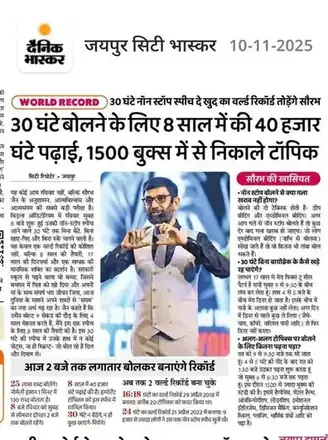
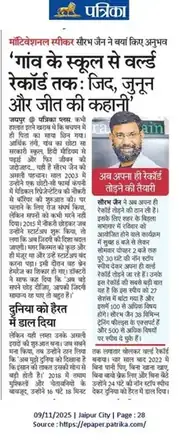
500+ media houses have covered Saurabh Jain, from Dainik Bhaskar and Rajasthan Patrika to ANI and The Print. Tap any clipping to read it.

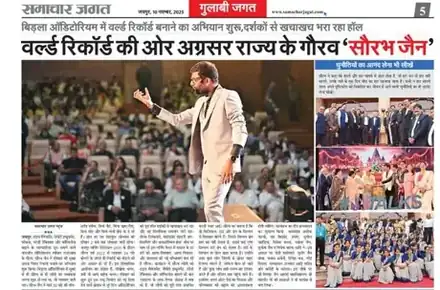
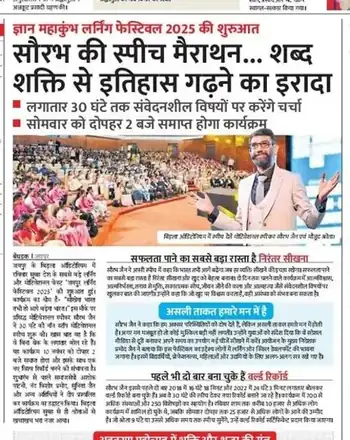
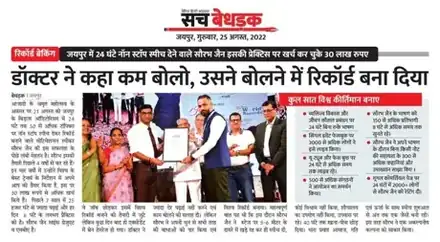
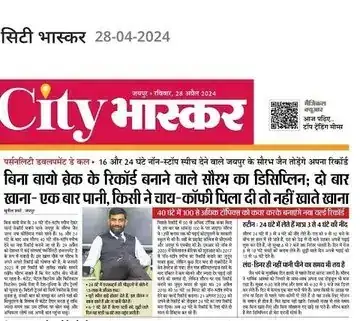
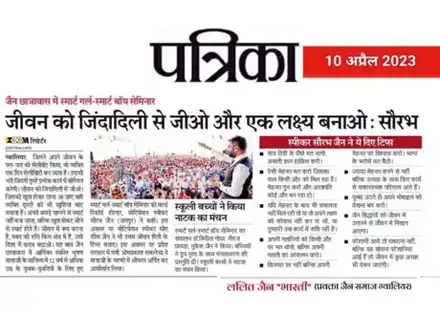
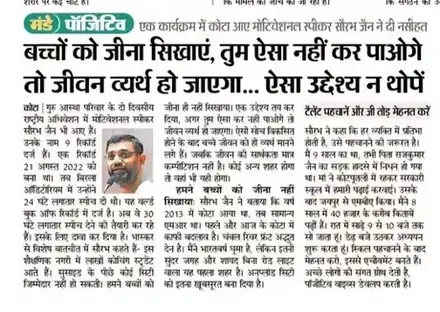
See how he holds a room and makes professionalism feel natural: the same presence your people learn to bring to every client and every meeting. Press play on any one.
“The take-away of the sessions was useful for me to take a few decisions in a positive manner. The special session on leadership communication was brilliant, and I would like to appreciate the method and technique.”
“An amazing experience with a great, witty personality. His sessions are full of skill, vast knowledge and very practical activities that cement and synchronise teams. In his words: I am not an entertainer, I am a trainer.”
“The entire team thoroughly enjoyed the activities. The session was engaging, well-structured and thoughtfully conducted, with activities, debriefs and delivery perfectly aligned with our objectives.”
Choose what is hurting your team. See the result, the shift and how it will feel, for your people and for your organisation.
Hover over or tap each card to see the shift people experience with Saurabh Jain.
1% better every day compounds to about 37 times better in a year. 1% worse every day shrinks to almost nothing.
Most behaviour-training proposals die in one meeting, on one of these five sentences. Tap yours and walk in with the answer. The decision stays yours.
If nothing changes: Everyone 'knows', yet the same late starts, loud calls and blame games repeat every single week.
Knowing is not doing. Behaviour changes through practice, feedback and repetition, not reminders. Your team rehearses each habit in real situations until it becomes automatic.
Proof: LinkedIn's Global Talent Trends report found 89% of recruiters say that when a hire does not work out, it usually comes down to soft skills.
If nothing changes: Training that cannot show results is the first budget line cut, and the complaints continue.
We agree the measures with you upfront: pre and post behaviour scores, manager observations, a 21‑day logbook, and a 90‑day look at complaints, meeting punctuality and attrition.
Proof: SHRM estimated that toxic workplace culture cost US employers $223 billion in turnover over five years (SHRM, 2019).
If nothing changes: Your people already lose hours every week to late starts, interruptions and friction.
Half-day modules, staggered batches so operations never stop, weekly or online sessions, and habits that take seconds inside the workday.
Proof: Psychologist David Meyer's research suggests switching back and forth between tasks can cost up to 40% of a person's productive time.
If nothing changes: A session that fades is the costliest kind: you pay once, then keep paying in complaints and lost clients.
Events fade when practice ends with them. Ours continues: a 21‑day logbook, daily micro-habits, buddy check-ins and refresher sessions.
Proof: Across 317 experiments, learning spaced out over time was remembered far better than the same learning crammed into one day (Cepeda, Psychological Bulletin, 2006).
If nothing changes: Every quarter of waiting adds more complaints, more conflict and more resignation letters.
Bad behaviour does not wait for appraisals to end, and good people rarely complain before they resign.
Proof: Gallup estimates managers account for at least 70% of the variance in team engagement. Every month a manager models poor behaviour, the team copies it.
Before you decide, see what poor behaviour quietly costs your organisation every year: days lost to conflict and complaints, hours lost to late starts and interruptions, and good people who quit a disrespectful culture. Cisco once estimated incivility cost it about $12 million a year (Porath and Pearson, HBR 2013). We use your own salary numbers and keep every assumption conservative.
If your people work with colleagues or clients, their behaviour is your brand, trained or not. Pick a group and see what changes for your organisation.
“Meetings start late, and half the room is on their laptops.”
Punctual, focused meetings where people listen and respect each other's time.
“One curt reply, and we lose the customer for life.”
People whose look, tone and manners win customers before the pitch begins.
“Every shift handover turns into a blame game.”
Respectful shifts, cleaner shared spaces and handovers without blame.
“Patients notice how we speak to each other.”
Calm, courteous teams who protect privacy and respect every person.
“I spend half my week settling politics and complaints.”
Leaders who model respect, give feedback privately and build ownership.
32+ industries. One proven way to build respectful, professional, high-trust teams.
Pick a duration and a setting. We shape the rest around your people and your calendar.
Your team may have attended a grooming talk or a policy briefing. It sounded right for a day. Here is why our change lasts, and shows up in every meeting.
It is not "Can we afford an etiquette program?"
It is "Can we afford another year of lost clients, conflict and resignations?"
Saurabh Jain is a Jaipur-based workplace etiquette and behavioural trainer, soft skills coach and corporate trainer with 23+ years of experience. He founded EnactraX, Bharat's No. 1 Soft Skills Training Centre, and the Jaipur Learning Festival, has conducted 2,500+ trainings across 32+ industries, holds 10 World Records, including a 30‑hour non-stop speech without any break, and has received 200+ awards. His Workplace Etiquette and Behavioural Training for Your Team turns everyday professional behaviour, from punctuality and tone to confidentiality and ownership, into habits people practise every day.
Workplace etiquette is the visible side of respect: how people look, use shared spaces, treat time, talk about and to each other, give feedback and handle mistakes. Behavioural training turns those standards into daily habits through role-play, feedback and follow-up. The research is clear that behaviour drives results: in Google's Project Aristotle study of 180 teams, psychological safety, the confidence that colleagues will not embarrass or punish you, was the strongest factor in team effectiveness. Every topic in this program is backed by psychology, neuroscience and real workplace studies.
Twelve practical topics in seven sections: personal hygiene and professional dress code; shared space misconduct in pantries, washrooms and desks; noise disregard and phone etiquette; chronic lateness and respect for time; gossip and office politics; interrupting and the art of listening; oversharing, confidentiality and professional boundaries; tone of voice in person, email and WhatsApp; public criticism; respect and regard for hierarchy; multi-tasking during meetings; and moving from an excuse and blame mindset to ownership. It suits corporate and IT teams, sales, service and call-centre teams, manufacturing and shift teams, healthcare and frontline teams, new joiners, managers, HR and leaders.
Stronger first impressions with clients; cleaner, quieter shared spaces; meetings that start on time and finish faster; less gossip, politics and conflict; confidential information that stays confidential; respectful emails and conversations; feedback given privately; people who disagree respectfully with seniors; full attention in meetings; and a culture of ownership instead of blame. Results are tracked through pre and post behaviour scores, manager observations, a 21‑day logbook and the complaint, punctuality and attrition data you already have.
No. It is practical, interactive and respectful. Sensitive topics such as personal hygiene, body odour and dress are taught as general professional standards, with humour and dignity, and no participant is ever singled out. Managers also learn how to raise a personal grooming issue privately and kindly. Standards are adapted to your culture, roles, uniforms and Indian as well as global client expectations.
Half day, full day, a few days, or regular weekly or monthly sessions. Saurabh Jain delivers in-person workplace etiquette training anywhere in the world from his Jaipur base: your office, plant, hotel or offsite, across Rajasthan, every Indian city and internationally. Live online sessions are available in any time zone, in English, Hindi or a mix of both.
The investment depends on duration, setting, number of participants and customisation, so every organisation gets a customised proposal within one working day of the discovery call. The behaviour ROI calculator on this page compares the cost with the hours lost to late starts, interruptions and conflict, and the attrition your organisation can recover.
Every participant rates their professional habits before and after, role-plays the key situations and leaves with a personal etiquette commitment and a 21‑day logbook. We agree organisational measures with you upfront, such as meeting punctuality, client feedback, complaints and attrition. Each participant receives a certificate and a workbook, and your organisation receives a summary of the change.
Knowing is not doing. In Princeton's famous Good Samaritan study, seminary students in a hurry, some on their way to give a talk about the Good Samaritan, mostly walked past a person in need: only about 10% stopped, against 63% of those who were not rushed (Darley and Batson, 1973). Pressure, habit and the people around us drive behaviour more than knowledge does. That is why your team practises each habit, gets feedback and repeats it until it is automatic.
We agree the measures with you upfront, across all four Kirkpatrick levels: participant reaction, a pre and post behaviour check, a 21‑day logbook with manager observations, and a 90‑day look at meeting punctuality, complaints, client feedback, escalations and attrition. You see what changed in behaviour and in business results, not just who attended.
Last updated: · Reviewed by Saurabh Jain
HR and L&D leaders: tell Saurabh Jain about your people, the behaviours you want to change and the culture you want to build. Free discovery call, no obligation, and a reply within 2 working hours.
Takes less than a minute.
We understand your team, their pressures and your goals.
Within one working day, shaped to your team.
Every great series ends with a celebration. With Saurabh Jain, yours starts on the last day of the program and never really ends.
Certificates, a team that has seen itself in the mirror, and people who walk out more confident, courteous and proud.
The logbook is complete. On-time starts, phones face down and private feedback now happen without thinking.
Fewer complaints, calmer meetings and a culture where "my mistake, here is my fix" is normal.
Respect compounds. Every courteous person sets the standard for the next, and the habits stay with your people for life, at work and at home.
Respect is not a policy. It is a habit: 1% more on time, 1% kinder, every single day.
Saurabh Jain